
Having two bosses might sound like a recipe for confusion. One wants you to focus on your department’s priorities, while the other needs your help with an important project. So, who gets the final say?
This is the reality of working in a matrix structure, where employees report to more than one manager and collaborate across different teams. While this approach can make organizations more flexible and improve how resources are shared, it can also create competing priorities and unclear responsibilities.
So, how does a matrix structure work, and what makes it effective for some organizations but challenging for others?
What Is a Matrix Structure, and How Does It Work?
A matrix structure is an organizational model where employees report to both a functional manager and a project manager. It combines traditional departments with cross-functional teams, allowing organizations to share expertise and resources across different projects.
Imagine you’re a marketing specialist working on a new product launch. Your marketing manager oversees your regular responsibilities and professional development, while the project manager coordinates your contributions to the launch. You remain part of the marketing department but collaborate with colleagues from other teams to achieve a shared goal.
Matrix Organization vs. Traditional Organization
The main difference between a matrix organization and a traditional organizational structure is how responsibilities and authority are distributed.
- Reporting relationships: Traditional organizations typically have a single reporting line, while matrix organizations involve multiple managers.
- Team structure: Traditional organizations primarily organize work within departments, while matrix organizations bring employees together across functions.
- Decision-making: Traditional structures follow a defined hierarchy, while matrix structures distribute authority between functional and project managers.
- Resource allocation: Traditional organizations generally allocate resources within departments, while matrix organizations allow expertise and resources to be shared across projects.
Neither approach is necessarily better. Traditional structures provide clearer reporting relationships, while matrix structures offer greater flexibility for organizations managing cross-functional projects.
Weak, Balanced or Strong? The Three Types of Matrix Structures
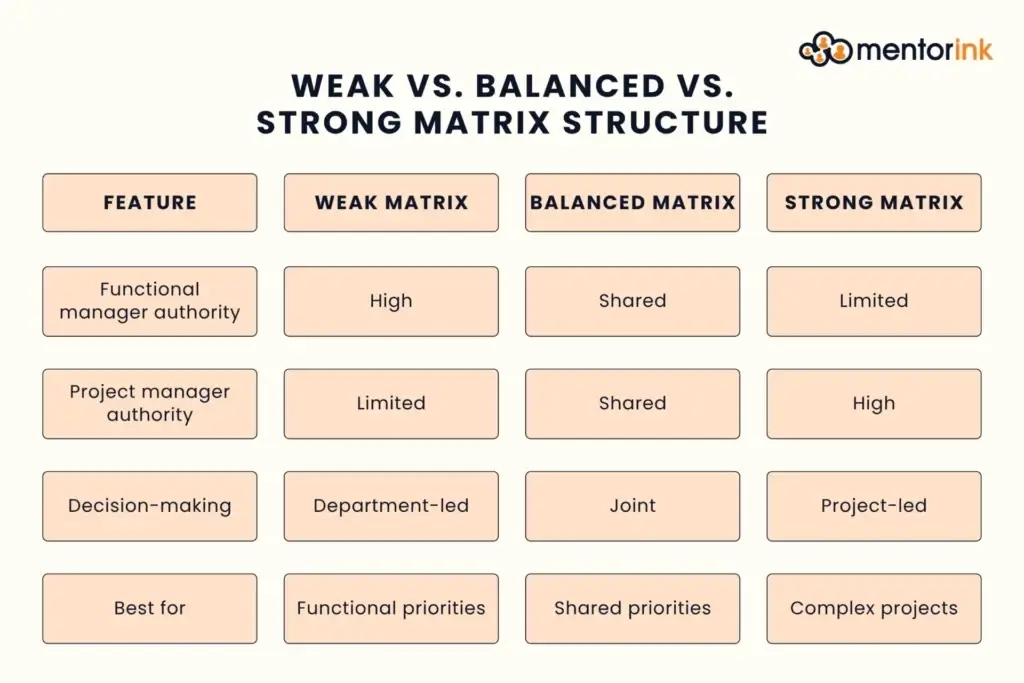
Not all matrix organizations distribute authority in the same way. Some give department managers greater control, while others place more responsibility in the hands of project managers. The three main types of matrix structures differ in how they balance these roles.
Functional (Weak) Matrix: The Department Calls the Shots
In a functional matrix organization, department managers retain most of the decision-making authority. Project managers primarily coordinate activities, monitor progress and help teams stay on schedule.
For example, a marketing specialist might contribute to a company-wide project, but their marketing manager still determines how much time they can dedicate to it. This structure works well for organizations that want to introduce cross-functional collaboration without significantly changing their existing hierarchy.
Balanced Matrix: Sharing the Authority
A balanced matrix organization gives functional and project managers relatively equal authority. Both managers contribute to decisions about employee responsibilities, project priorities and resource allocation.
For example, when an employee is assigned to a new project, both managers may agree on how to divide their workload between regular departmental tasks and project activities.
This approach encourages shared accountability, but it also requires managers to communicate regularly to prevent conflicting expectations.
Strong Matrix: The Project Manager Takes the Lead
In a strong matrix organization, project managers have greater authority over project-related decisions, including budgets, schedules and resource allocation. Functional managers continue to provide technical expertise and support employees’ professional development.
Consider a software company developing a new product. The project manager may determine priorities and assign work across departments, while functional managers ensure their team members have the skills and support needed to deliver.
This structure is particularly useful for organizations where complex projects play a central role in business operations.
Advantages and Disadvantages of Matrix Structure: The Good and the Complicated
The flexibility of a matrix structure comes with trade-offs. Here’s where it can benefit organizations and where challenges are most likely to arise.
Advantages of Matrix Structure: Where Collaboration Pays Off
- Better use of resources: Instead of assigning employees exclusively to one department or project, organizations can share expertise where it’s needed most. This helps make better use of existing talent without creating separate teams for every initiative.
- More opportunities to learn: Working with colleagues from different departments exposes employees to new perspectives and ways of working. This can support professional development and help employees build skills beyond their usual responsibilities.
- Stronger cross-functional collaboration: Bringing specialists together makes it easier to exchange knowledge and solve problems that involve multiple departments. It can also reduce information silos that limit communication between teams.
- Greater flexibility: When a new project begins or business priorities change, organizations can bring in specialists from different departments without creating entirely new teams. For example, a product launch might temporarily involve employees from marketing, sales and customer support, who return their focus to regular responsibilities once the project is complete.
Disadvantages of Matrix Structure: When Collaboration Gets Complicated
- Conflicting priorities: Employees may receive competing requests from functional and project managers, making it difficult to determine which tasks should take precedence.
- Unclear responsibilities: When authority is shared, employees and managers may be uncertain about who makes final decisions or takes responsibility for outcomes.
- Slower decision-making: Involving multiple managers in decisions can lead to longer discussions and approval processes, particularly when their priorities differ.
- Increased workload and stress: Balancing departmental responsibilities with project commitments can become overwhelming when managers don’t coordinate expectations or monitor employee capacity.
These challenges don’t necessarily outweigh the benefits. However, they highlight why a successful matrix structure depends on clear responsibilities, realistic workloads and effective coordination between managers.
Matrix Organization Examples: Who’s Making It Work?
Matrix structures have been used by organizations across different industries, but they don’t always work the same way. NASA and Unilever offer two interesting examples.
NASA: Bringing Different Experts Together
NASA uses matrix structures within parts of its operations to bring specialized employees into different projects. In a 2023 NASA podcast, a safety director describes how engineers and other specialists work across programs while remaining part of their functional teams.
This approach allows NASA to share technical expertise across complex missions.
Unilever: When the Matrix Becomes Too Complex
Unilever operated under a matrix structure for years, combining global divisions with regional management. However, in 2022, the company moved away from this model, introducing five business groups with greater responsibility for their own performance.
As explained in Unilever’s 2022 Annual Report, the change aimed to simplify operations and make decision-making faster.
Unilever’s experience shows that organizational structures may need to evolve as business priorities change. Even an established matrix model may require adjustments to improve accountability and decision-making.
Making a Matrix Structure Work Without the Chaos
The success of a matrix structure depends less on the organizational chart and more on how people work within it. A few management practices can make a significant difference.
Make Responsibilities Clear from the Start
Employees should know which manager oversees their daily responsibilities, who makes project-related decisions and how conflicting priorities will be resolved. Defining these expectations early helps prevent confusion and unnecessary delays.
Keep Managers on the Same Page
Functional and project managers need to communicate regularly about workloads, deadlines and changing priorities. Rather than leaving employees to resolve conflicting requests themselves, managers should agree on expectations and make adjustments together.
Turn Cross-Functional Work into Learning Opportunities
Working across departments gives employees opportunities to learn from colleagues with different expertise. Organizations can build on these experiences through mentoring programs, where employees share knowledge beyond their immediate teams and receive guidance from experienced colleagues.
This helps make professional development a meaningful part of cross-functional collaboration rather than simply an additional responsibility.
Is a Matrix Structure Right for Your Organization?
A matrix structure can be a good fit for organizations managing complex projects that require expertise from different departments. It allows teams to share resources and adapt to changing priorities without constantly reorganizing.
However, not every organization needs this level of flexibility. For smaller companies with straightforward workflows, a traditional structure may provide greater clarity with less coordination.
Ultimately, the right organizational structure depends on how your teams work. A matrix approach can create valuable opportunities for collaboration and growth, but its success relies on clear responsibilities and managers who work together rather than compete for authority.
Frequently Asked Questions About Matrix Organizations
What Is the Biggest Challenge of a Matrix Organization?
One of the biggest challenges is managing conflicting priorities. When employees receive different instructions from functional and project managers, unclear decision-making authority can lead to delays and frustration.
What Is the Difference Between a Matrix and a Functional Organization?
A functional organization groups employees by department, with each person typically reporting to one manager. A matrix organization maintains these departments while allowing employees to work across teams under shared management.
Can Small Businesses Use a Matrix Structure?
Yes, small businesses can adopt a matrix structure, particularly when employees regularly contribute to projects outside their departments. However, the additional coordination may not be worthwhile for businesses with simple operations.
Is a Matrix Structure Good for Employees?
It can be. Working across departments may expose employees to new skills, different perspectives and greater career development opportunities. However, unclear expectations and competing workloads can create stress if managers don’t coordinate effectively.