Landing a job interview is a great first step, especially in a competitive job market where getting noticed can be challenging. Now comes the part where preparation, communication and a few small details can make all the difference.
If you are wondering how to ace a job interview, it is not about memorizing the perfect answer to every possible question. A strong interview usually comes down to knowing how to prepare, understanding what the employer is looking for and showing up as a clear, confident and genuine version of yourself.
From researching the company and preparing for common interview questions to figuring out what to wear to a job interview and knowing when to follow up, there is a lot to think about. To make it easier, here are the most important job interview do’s and don’ts to keep in mind before, during and after your interview.
How to Prepare for an Interview
Knowing how to prepare for an interview can help you feel more confident and avoid unnecessary stress before the conversation even starts.
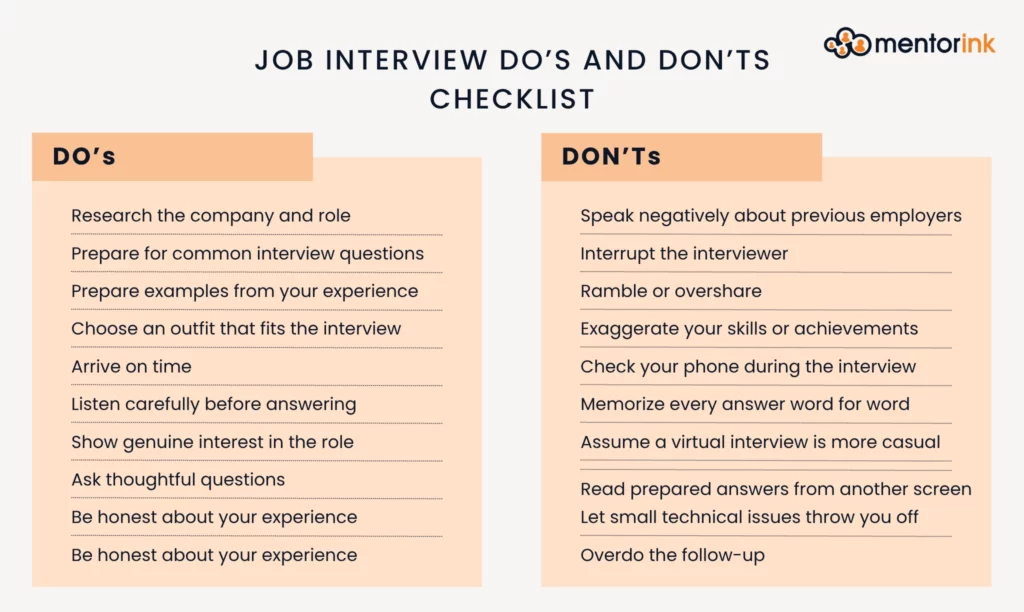
1. Do Research the Company and the Role
Go beyond the company homepage. Look at what the company does, who it serves, its values and any recent projects or updates.
Then review the job description again and identify the skills and responsibilities that seem most important. This will help you connect your own experience to what the employer is actually looking for.
If you know who will be interviewing you, a quick look at their professional background can also help you understand who you will be speaking with.
2. Do Prepare for Common Interview Questions
You cannot predict every question but you can prepare for the ones that appear in most job interviews.
Common interview questions include:
- Tell me about yourself.
- Why are you interested in this role?
- Why do you want to work for this company?
- What are your strengths and weaknesses?
- Tell me about a challenge you faced at work.
- Why are you leaving your current role?
Practice the key points you want to cover but do not memorize your answers word for word. Interviews are conversations and overly rehearsed answers can quickly sound unnatural.
3. Do Prepare Examples From Your Experience
Do not just say you are a good communicator, problem-solver or team player. Be ready to show it.
Think of a few examples from your work, education or projects that demonstrate the skills mentioned in the job description.
For behavioral questions, the STAR method can help you structure your answer around the Situation, Task, Action and Result.
A few strong examples are usually enough. If you want to make those examples stronger, Harvard’s Mignone Center for Career Success also provides a useful list of action verbs you can use when describing your achievements and responsibilities, such as led, improved, coordinated, developed and implemented.
4. Do Know What to Wear to a Job Interview
Wondering what to wear to a job interview? There is no single outfit that works for every company, but first impressions still count.
Look at the workplace culture and aim for something slightly more polished than the everyday norm. Your outfit should be professional, clean and comfortable.
The same applies to virtual interviews. Choose something that looks professional on camera without becoming a distraction.
The goal is simple: let the interviewer focus on you and what you have to say, not what you are wearing.
5. Do Prepare for the Interview Format
Find out what type of interview you are walking into.
It could be an in-person meeting, video call, panel interview or a technical or case-based interview. Knowing the format helps you prepare accordingly.
For an in-person interview, check the location and route beforehand. For an online interview, test your camera, microphone, internet connection and meeting link.
If you are not sure what to expect, ask the recruiter.
Virtual Interview Do’s and Don’ts
We have already covered a few virtual interview tips above but online interviews come with their own small set of challenges. So, here is a quick checklist you can use before your next video interview.
Do:
- Test your camera, microphone and internet connection beforehand.
- Join the meeting a few minutes early.
- Choose a quiet, well-lit space.
- Turn off unnecessary notifications and close distracting tabs.
Don’t:
- Don’t read prepared answers directly from another screen.
- Don’t multitask or check messages during the interview.
- Don’t panic if a small technical issue happens. Explain it and reconnect.
- Don’t assume a virtual interview is more casual than an in-person one.
Bonus tip: Don’t wear pajama bottoms under your polished interview outfit just because the camera cannot see them. Dressing properly from head to toe can actually help you switch into interview mode and feel more focused.
Yes, technically nobody will know. But you will.
Most of the same job interview do’s and don’ts apply whether you are meeting online or in person. The main difference is that in a virtual interview, your technology and environment become part of your preparation too.
Now, let’s move on to the interview itself.
What to Do During a Job Interview
Preparation gets you ready for the conversation. What happens next depends on how well you listen, communicate and respond in the moment.
6. Do Arrive on Time
For an in-person interview, leave enough time to find the location and settle in without rushing.
For a virtual interview, join a few minutes before the scheduled time in case you run into a last-minute technical issue.
If something unexpected makes you late, let the interviewer know as soon as possible.
7. Do Listen and Keep Your Answers Focused
Let the interviewer finish the question before responding and listen carefully to what they are actually asking.
If you need a few seconds to think, take them. If the question is unclear, ask for clarification.
When answering, stay focused on the question rather than adding every detail you can think of. Give enough context to make your point but avoid turning a simple answer into a ten-minute story.
8. Do Be Honest About Your Experience
You do not need to know everything to make a good impression.
Be clear about the skills and experience you have and avoid exaggerating responsibilities, achievements or tools you have used. Follow-up questions can quickly reveal inconsistencies.
If you have not done something before, talk about related experience or explain how you would approach learning it.
9. Don’t Speak Negatively About Previous Employers
Even if you had a difficult experience at a previous job, an interview is rarely the best place for a long complaint.
If you are asked why you left, focus on what you learned and what you are looking for next.
You can be honest about a difficult situation without turning the conversation into criticism of a former manager, colleague or company.
10. Do Show Interest and Ask Thoughtful Questions
An interview is a two-way conversation.
Engage with what the interviewer tells you about the role, team and company rather than simply waiting for your next prepared answer.
And when they ask, “Do you have any questions for us?” try not to answer with a quick “No.”
You could ask:
- What would success look like in this role during the first six months?
- What are the biggest priorities for the person joining the team?
- How does the team usually work together?
- What is one challenge the person in this role is likely to face?
- What are the next steps in the interview process?
Good questions help you evaluate the opportunity while showing that you are genuinely interested in it.
What to Do After an Interview
The conversation may be over but there is still one final step worth getting right.
11. Do Follow Up, But Don’t Overdo It
A short thank-you email after the interview can be a good way to reinforce your interest.
Thank the interviewer for their time, mention something specific from the conversation and briefly confirm that you are interested in the role.
If they gave you a timeline for the next steps, wait until that period has passed before checking in again.
Following up once shows interest. Sending repeated emails or contacting several people for the same update can quickly become too much.
Final Thoughts
If you are trying to figure out how to ace a job interview, focus less on delivering perfect answers and more on being prepared, clear and genuine.
Research the company, prepare for likely interview questions and think through examples from your experience. During the interview, listen carefully, stay focused and remember that you are also there to decide whether the opportunity is right for you.
The best interviews often feel less like an interrogation and more like a useful conversation between two sides trying to understand whether they are a good match.
Good luck with your next job interview!