
How many employee departures could have been prevented? More than we might think. Gallup’s research found that 42% of U.S. employees who voluntarily left their jobs believed their employer or manager could have done something to keep them.
Some employee turnover is inevitable. People move on for different reasons, and not every departure signals a problem. But when employees leave frequently, organizations face more than the cost of finding replacements. They also risk losing valuable experience and placing additional pressure on the people who stay.
Understanding your turnover rate can help you recognize when employee departures are becoming a concern and what you can do about them.
Employee Turnover Rate: What Does It Really Tell You?
Employee turnover rate is the percentage of employees who leave an organization during a specific period, usually measured monthly or annually. It helps organizations understand how frequently employees leave and whether workforce stability may be becoming a concern.
Employee turnover generally falls into two categories:
- Voluntary turnover: When employees choose to leave, whether to pursue another opportunity, change careers or for personal reasons.
- Involuntary turnover: When employment ends at the organization’s initiative, such as through layoffs or terminations.
Not all employee turnover is negative. Some departures are expected, while others may indicate underlying workplace issues.
What Counts as a High Turnover Rate?
A high turnover rate occurs when employee departures are frequent relative to the size of an organization’s workforce. However, there is no single percentage that defines high turnover across every industry.
For example, seasonal businesses may experience higher turnover than organizations with more stable, specialized roles. What matters is how the rate compares with relevant industry benchmarks and the organization’s own historical data.
When Does Turnover Become a Problem?
Turnover becomes concerning when departures begin to disrupt the organization or reveal recurring problems that remain unresolved.
A sudden increase in resignations may be an early warning sign, especially when experienced employees or people in critical roles are leaving. Repeated departures within the same team can also indicate issues that deserve closer attention.
Rather than looking at the turnover percentage alone, organizations should examine who is leaving, why they are leaving and how those departures affect the remaining workforce.
Let’s Do the Math: Calculating Your Turnover Rate
Knowing how many employees left your organization is useful, but that number alone doesn’t tell you much. Losing five employees in a company of 30 is very different from losing five in a company of 500.
That’s why employee turnover rate is expressed as a percentage. It measures departures relative to the average size of your workforce over a given period.
The Formula Behind the Numbers
The turnover rate formula is straightforward:
Turnover Rate (%) = (Number of Employees Who Left ÷ Average Number of Employees) × 100
To find the average number of employees, add your headcount at the beginning and end of the period, then divide by two.
Average Headcount = (Starting Headcount + Ending Headcount) ÷ 2
Let’s Put It into Practice
Imagine your company started the year with 100 employees and ended with 110. During that year, 15 employees left.
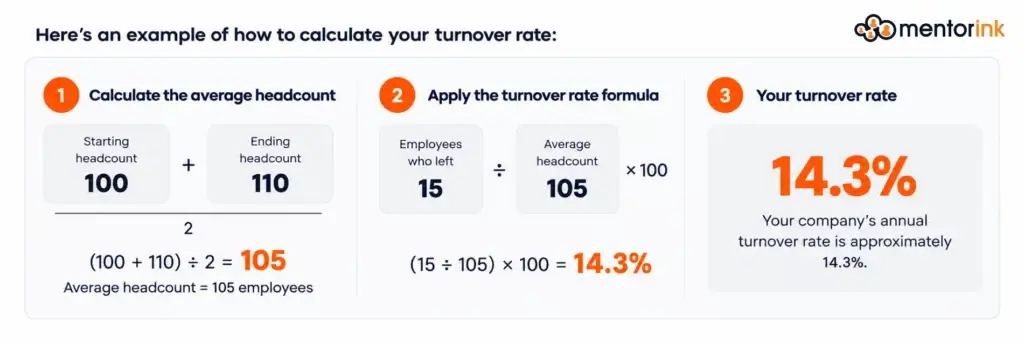
But calculating your turnover rate is only the beginning. The more important question is what that number actually means for your organization.
Is Your Turnover Rate Healthy? Here’s How to Tell
A 10% turnover rate might be perfectly reasonable for one company and a cause for concern at another. So, how do you know whether your number is actually good?
The answer depends on context. There is no universal benchmark for a healthy employee turnover rate. Industries with seasonal employment or frequent short-term contracts naturally experience more employee movement than organizations with specialized, long-term roles.
Instead of judging your turnover rate against a single number, consider a few questions:
- How does it compare with your industry? Look at benchmarks from similar organizations, ideally in the same region.
- Is your turnover rate increasing? A sudden rise compared with previous years may deserve attention, even if your overall rate appears reasonable.
- Who is leaving? Losing experienced employees in critical positions can have a greater impact than the overall percentage suggests.
- Why are they leaving? Voluntary resignations may tell a different story from departures caused by restructuring or layoffs.
It’s also worth remembering that a low turnover rate doesn’t automatically mean employees are happy. Some people stay because they have limited alternatives, not necessarily because they’re satisfied with their workplace.
Ultimately, a healthy turnover rate isn’t simply the lowest possible number. It’s one that makes sense for your organization and doesn’t undermine its ability to retain the people it needs.
Why Are Employees Leaving? 5 Common Causes of High Turnover
Employees don’t always leave because something is wrong. A better opportunity, a career change or personal circumstances can all lead someone to move on. But when departures become a pattern, it’s worth looking more closely at what’s happening inside the organization.
Here are five common factors that can contribute to a high employee turnover rate.
1. Poor Management and Leadership
Managers have a significant influence on how employees experience their work. Poor communication, micromanagement or inconsistent expectations can make even an otherwise rewarding job frustrating.
When employees feel unsupported or believe their concerns aren’t taken seriously, their relationship with the organization may gradually weaken. Over time, leaving can start to seem like the better option.
2. Inadequate Compensation and Benefits
People want to feel fairly compensated for their work. When salaries fall behind market expectations or employees see better opportunities elsewhere, staying becomes a harder decision.
Compensation also goes beyond salary. Paid leave, healthcare benefits and flexibility can influence how employees evaluate their overall employment experience.
3. Limited Career Growth Opportunities
Imagine doing the same job for years without seeing a clear path forward. Even employees who enjoy their work may eventually wonder what comes next.
A lack of promotion opportunities isn’t the only concern. Employees may also leave when they have little chance to develop new skills or take on meaningful challenges.
4. Toxic Workplace Culture
Favoritism, unresolved conflicts and unfair treatment can undermine employees’ trust in their workplace.
These experiences don’t necessarily affect everyone equally. One department may have a supportive environment while another struggles with ongoing tensions. This is why looking at turnover across individual teams can be just as important as tracking the organization-wide rate.
5. Poor Work-Life Balance and Burnout
An occasional busy period is one thing. Constantly working under pressure without enough time to recover is another.
When excessive workloads become the norm, employees may struggle to maintain a healthy balance between their professional and personal lives. Even highly committed employees can reach a point where leaving feels like the only way to regain that balance.
How Can You Reduce Employee Turnover Before It’s Too Late?
Knowing why employees leave is important. But what organizations do with that information matters even more.
Reducing employee turnover isn’t about convincing everyone to stay forever. It’s about addressing avoidable problems before they become reasons to leave.
1. Listen Before Employees Decide to Leave
Exit interviews can reveal valuable insights, but by the time someone resigns, the opportunity to retain them may already be gone.
Consider conducting regular stay interviews to understand what employees enjoy about their work and what might make them consider leaving. Anonymous feedback surveys can also help uncover concerns that employees may hesitate to raise directly.
Most importantly, act on what you learn. Asking for feedback without making meaningful changes can do more harm than good.
2. Make Compensation Worth Staying For
Review salaries regularly against market benchmarks and ensure that compensation decisions are fair.
Pay isn’t everything, but it can be difficult to retain employees who feel consistently undervalued. Benefits should also reflect what employees actually need, rather than simply offering the same package year after year.
3. Give Employees a Future to Look Forward To
Not everyone wants a promotion, but most employees want opportunities to grow.
Provide access to training, encourage internal mobility and make career development conversations part of regular performance discussions. Mentoring and coaching can also help employees explore their goals and develop capabilities for future opportunities.
The aim is to help people see that their next career move doesn’t necessarily have to involve leaving the organization.
4. Build a Workplace People Want to Stay In
A positive employee experience depends on more than occasional recognition or team activities. Employees need supportive managers, fair treatment and workloads they can realistically manage.
Invest in leadership development and encourage managers to address concerns early. Recognize contributions consistently and make sure workplace policies reflect the values your organization promotes.
Finally, keep monitoring your turnover rate. Improvements may take time, but tracking patterns can help you understand whether your efforts are making a difference.
Beyond the Numbers: Making Employee Retention Count
A turnover rate can tell you how many employees are leaving, but it can’t explain the full story behind their decisions. That’s where listening to employees and understanding their experiences becomes just as important as tracking the numbers.
Some departures will always be inevitable. What matters is recognizing the ones that could have been prevented and creating an environment where employees have good reasons to stay.
After all, the goal isn’t simply to achieve a lower turnover rate. It’s to build a workplace people genuinely want to be part of.
Frequently Asked Questions About Turnover Rate
Is high turnover a red flag?
Yes, a high turnover rate can be a red flag, especially when employees repeatedly leave the same department or resign unexpectedly. However, high turnover doesn’t always indicate a poor workplace. Seasonal employment, restructuring and industry-specific trends can also influence the rate.
Is 20% a high turnover rate?
An annual turnover rate of 20% may be considered high in some industries, but there is no universal threshold. For example, it may be more concerning in an organization with specialized, long-term positions than in a business that relies heavily on seasonal workers.
Is 5% a good turnover rate?
An annual turnover rate of 5% generally indicates relatively low employee movement. While this can be a positive sign, it doesn’t automatically mean employees are satisfied. Organizations should also consider employee feedback and whether people have opportunities to grow.
What is the difference between turnover rate and retention rate?
Turnover rate measures employee departures relative to the average workforce size during a given period. Retention rate measures the percentage of employees from a starting group who remain employed at the end of that period. Both help organizations evaluate workforce stability, but they measure different things.
Can employee turnover rate be too low?
Potentially. A very low turnover rate can indicate workforce stability, but it may also raise questions about internal mobility or opportunities for new talent to enter the organization. The percentage alone isn’t enough to determine whether turnover is healthy.