DEI gets talked about a lot. Sometimes as a business priority, sometimes as a policy, sometimes as a training topic, and sometimes as a three-letter acronym everyone is expected to understand already.
At its core, DEI stands for diversity, equity and inclusion. It is about who gets access to opportunities, whose perspectives are represented, whether people are treated fairly, and whether they can actually participate once they are included.
And it is not only a workplace issue. DEI can shape how companies hire and promote, how NGOs design programs, how universities support students or how associations choose who gets access to leadership and development opportunities.
The tricky part? Diversity, equity and inclusion are connected, but they are not interchangeable. A diverse organization is not automatically inclusive. Treating everyone the same is not always equitable. And having a DEI policy does not necessarily mean anything is changing in practice.
So, rather than adding another long list of definitions to the internet, this guide looks at what DEI actually means in practice, what DEI programs and policies can look like, how organizations can turn those ideas into action, and where mentoring can support that work.
The short version
DEI is not only about who is included. It is also about who has access, who gets heard and who has the opportunity to grow.
What Is DEI?
Diversity, equity and inclusion are closely connected, but they answer different questions: Who is represented? Does everyone have fair access? And can people meaningfully participate once they are there?
That distinction matters. An organization can be diverse on paper and still have unequal access to opportunities, or strong policies without people actually feeling included.
What Is Diversity?
Diversity is about the range of people, perspectives and experiences represented within an organization.
It can include differences in race, ethnicity, gender, age, disability, sexual orientation, religion, socioeconomic background and culture, as well as education, professional experience, skills and ways of thinking.
In short: diversity asks, who is represented here?
Different perspectives can bring new approaches to problem-solving, decision-making and collaboration. But representation alone does not guarantee those perspectives will be heard.
What Is Equity?
Equity is about fair access to opportunities, resources and support.
Unlike equality, which focuses on giving everyone the same thing, equity considers whether people have different needs or face different barriers.
The same principle can apply to:
- development opportunities
- promotion and leadership access
- compensation
- accessibility
- flexible participation
- mentoring and sponsorship
Quick reality check
A process can look equal on paper and still create very different outcomes in practice.
Deloitte’s global disability inclusion research offers a good example. Among respondents who had requested workplace accommodations, 74% said at least one of their requests had been rejected.
What Is Inclusion?
If diversity is about who is present, inclusion is about what happens after they arrive.
Do people feel comfortable contributing? Are different perspectives taken seriously? Can someone disagree without immediately becoming that person in the meeting?
Inclusion is what turns representation into participation.
Catalyst research found that 88% of employees working in teams with highly inclusive norms reported high levels of job engagement.
The useful distinction is simple:
- Diversity: Who is represented?
- Equity: Does everyone have fair access?
- Inclusion: Can everyone participate and contribute?
You need all three. Otherwise, DEI can quickly become a numbers exercise rather than something people actually experience.
Why DEI Matters for Organizations
DEI is often framed as the right thing to do. For organizations, though, it also influences how people contribute, make decisions, develop and engage with the organization.
Better Perspectives Can Lead to Better Decisions
When everyone around the table has similar experiences, it is easier to arrive at similar answers.
Different perspectives can challenge assumptions, expose blind spots and introduce approaches that may otherwise be missed.
McKinsey’s analysis of more than 1,200 companies across 23 countries continued to find an association between greater gender and ethnic diversity in leadership and stronger financial performance. The researchers also expanded the discussion beyond financial results to areas such as talent attraction and social impact.
What this means
Diversity creates the possibility of different thinking. Inclusion determines whether that thinking makes it into the conversation.
Inclusion Can Strengthen Engagement
People are more likely to engage when they feel their contribution matters.
And the wider engagement picture leaves plenty of room for improvement. Gallup’s 2026 State of the Global Workplace report found that only 20% of employees worldwide were engaged at work in 2025, down one percentage point from the previous year. In Europe, the figure was just 12%.
Inclusion and engagement are not the same thing, of course. But expecting people to become deeply engaged while they feel ignored, excluded or unable to contribute is a fairly ambitious strategy.
Fairer Access Can Help More People Grow
Not every important opportunity comes with a job title.
Leadership programs, professional networks, mentoring, stretch assignments, visibility and access to decision-makers can all influence who develops and who moves forward.
Looking at these opportunities through a DEI lens helps organizations ask a more useful question than simply “Do we offer this?” Who is actually getting access to it?
For a company, that might mean examining access to leadership development. For an association, it could be committee or board opportunities. For a university or NGO, it might mean looking at who participates in, leads or benefits from a program.
What Is a DEI Program?
A DEI program is a structured effort designed to turn diversity, equity and inclusion goals into action.
What that looks like depends on the organization and the problem it is trying to solve. A company might focus on widening access to career development. An association might want broader participation in leadership. An NGO might be working to make its programs more accessible to the communities it serves.
Common DEI programs and initiatives can include:
- mentoring and sponsorship programs
- inclusive recruitment initiatives
- leadership development programs
- employee or member resource groups
- accessibility initiatives
- pay equity reviews
- learning and education
- initiatives focused on participation or representation
One workshop, awareness day or training session can support DEI, but it does not automatically make a DEI program.
A useful program usually has a problem to solve, a goal, a set of actions and a way to see whether anything changed.
What Is a DEI Policy?
A DEI policy outlines an organization’s principles, expectations and commitments around diversity, equity and inclusion.
A DEI program is about putting those commitments into action.
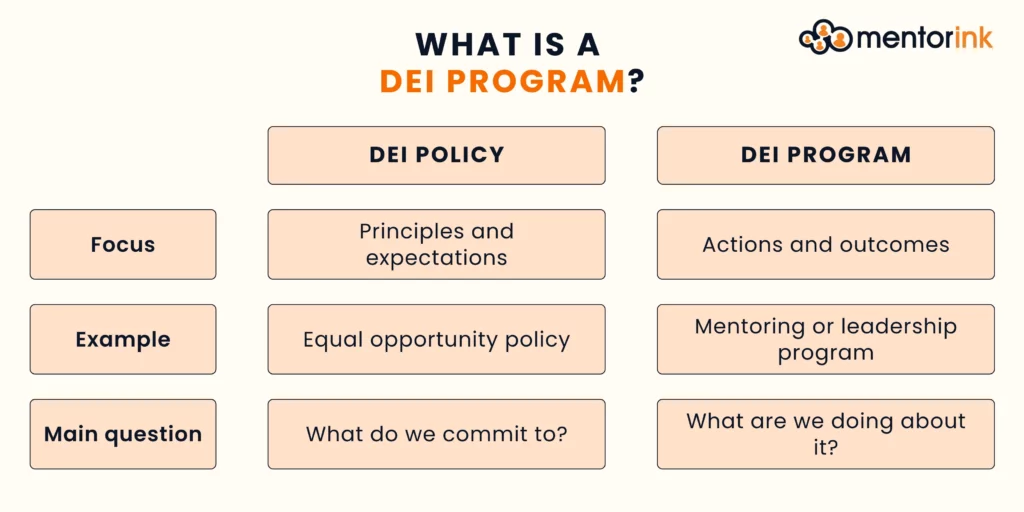
The two work best together. A policy without action risks becoming little more than a document. A program without clear principles can become a collection of disconnected activities.
What Is DEI in the Workplace?
In the workplace, DEI reaches much further than hiring.
It can influence recruitment, pay, promotion, accessibility, leadership development, performance processes, employee resource groups, mentoring and the way people participate in everyday decisions.
This is why workforce diversity numbers are useful, but incomplete. They can tell an organization who is there. They cannot tell it whether those employees are progressing, staying, contributing or having the same experience once they arrive.
For organizations running DEI programs, that distinction is important. The goal is not simply to create activity around DEI. It is to understand which part of the employee experience needs to change.
How to Build and Support DEI Initiatives in an Organization
There is no universal DEI checklist. A university, an NGO, a professional association and a global company can have completely different needs.
So copying another organization’s initiative because it looked good on LinkedIn is probably not the strongest starting point.
Start With the Current Reality
Before deciding what to launch, understand what is already happening.
Depending on the organization, that could mean looking at:
- representation across teams, levels or programs
- promotion and leadership patterns
- pay or access to resources
- participation in development opportunities
- retention or dropout rates
- employee, member or participant feedback
The aim is not to collect every DEI metric imaginable. It is to find the gaps that actually matter to your organization.
Define What Progress Looks Like
“Improve DEI” is a goal in roughly the same way that “get healthier” is a goal. Directionally useful. Not especially measurable.
A clearer goal might be to:
- increase access to leadership development
- improve representation at a specific level
- reduce gaps in program participation
- improve retention
- improve accessibility
- strengthen perceptions of belonging or fairness
Once the outcome is clearer, choosing the right initiative becomes much easier.
Review the Processes People Actually Experience
DEI does not live only in major campaigns. It often shows up in ordinary processes.
That can mean reviewing:
- recruitment and selection
- promotions
- compensation
- accessibility
- flexible working or participation
- performance evaluation
- learning and development
- leadership selection
This is where the difference between equality and equity becomes particularly practical. Following exactly the same process for everyone does not automatically mean the process creates fair access for everyone.
Build Awareness Without Turning DEI Into a Training Calendar
Training can help people recognize unconscious bias, understand exclusionary behaviors or develop more inclusive ways of leading and communicating.
What it cannot do is quietly repair every other organizational problem while everyone carries on as before.
If policies, incentives and decision-making processes remain unchanged, another two-hour workshop is unlikely to perform miracles.
Education works better when it supports a broader goal rather than becoming the goal itself.
Create Ways for People to Participate
Surveys, employee or member resource groups, listening sessions, advisory groups and community consultations can give organizations a clearer picture of how people actually experience their programs and policies.
But there is one small catch: someone has to do something with the feedback.
Asking people what they think and repeatedly changing nothing is a surprisingly efficient way to make them stop telling you.
Measure, Learn and Adjust
Launching the initiative is the beginning, not the KPI.
The right measures will depend on the original goal, but they might include:
- participation
- representation
- progression
- retention
- access to opportunities
- participant or employee feedback
Not every initiative will work exactly as expected. That is useful information too.
The important question is whether the program is changing the problem it was designed to address. If not, adjust it.
How Mentoring Can Support DEI Programs
Mentoring is not a complete DEI strategy. It can, however, be a very practical part of one.
At its best, mentoring creates structured opportunities for people to build relationships, gain guidance, develop skills and connect with people they may not otherwise meet.
For DEI programs, that opens up several possibilities.
Expand Access to Development and Networks
Professional development often happens through relationships as much as formal training.
Mentoring can create more structured access to:
- career guidance
- leadership development
- feedback
- professional networks
- organizational knowledge
- new perspectives and skills
Instead of leaving those connections entirely to chance, organizations can intentionally create opportunities for more people to build them.
Worth remembering
Mentoring and sponsorship are related, but they are not identical. Mentors generally advise and support. Sponsors actively advocate for someone’s advancement or opportunities.
Make Mentoring Part of a Broader DEI Strategy
This is also where expectations matter.
A mentoring program cannot compensate for unequal pay, inaccessible processes, biased promotion decisions or leadership that does not support inclusion. What it can do is help an organization address a specific development, connection or access gap as part of a broader DEI strategy.
That is why the strongest starting question is not:
“Should we launch a DEI mentoring program?”
It is:
“What are we trying to change, and could mentoring help us change it?”
How Mentorink Supports DEI-Focused Mentoring Programs
For organizations using mentoring as part of a DEI strategy, the challenge is not only creating meaningful matches. It is making sure the program is structured, accessible and measurable from start to finish.
Mentorink helps organizations manage that process in one place, including:
- participant applications and profiles
- flexible matching based on goals, preferences and program criteria
- guided journeys, reminders and progress tracking
- feedback, engagement monitoring and reporting
This can be especially useful for DEI-focused programs where organizations want to understand not only who participated, but also whether participants stayed engaged, built meaningful connections and progressed toward the goals the program was designed to support.
And importantly, technology does not have to make every decision. Mentorink can support automated matching recommendations while still allowing program managers to review, adjust and make the final call.
The goal is not to automate the human part of mentoring. It is to make the structure around it easier to manage, scale and improve.