
Mentoring programs are everywhere. But effective mentoring programs are not.
Many organizations launch mentoring initiatives with good intentions, only to see them lose momentum after the first few months. Meetings stop happening. Matches feel forced. Outcomes are hard to explain, let alone measure. This usually isn’t because mentoring doesn’t work. It’s because the program was launched without a clear purpose, structure, or support system.
Starting a mentoring program in 2026 requires more than pairing people up and hoping for the best. Today’s programs need to balance human connection with clarity, flexibility with structure, and personal growth with measurable outcomes.
This guide breaks down how to start a mentoring program step by step. Instead of focusing on theory, it focuses on practical decisions that shape successful programs, from defining purpose and choosing the right format to matching participants, supporting relationships, and measuring impact. If your goal is to build a mentoring program that lasts and makes a difference, you’re in the right place.
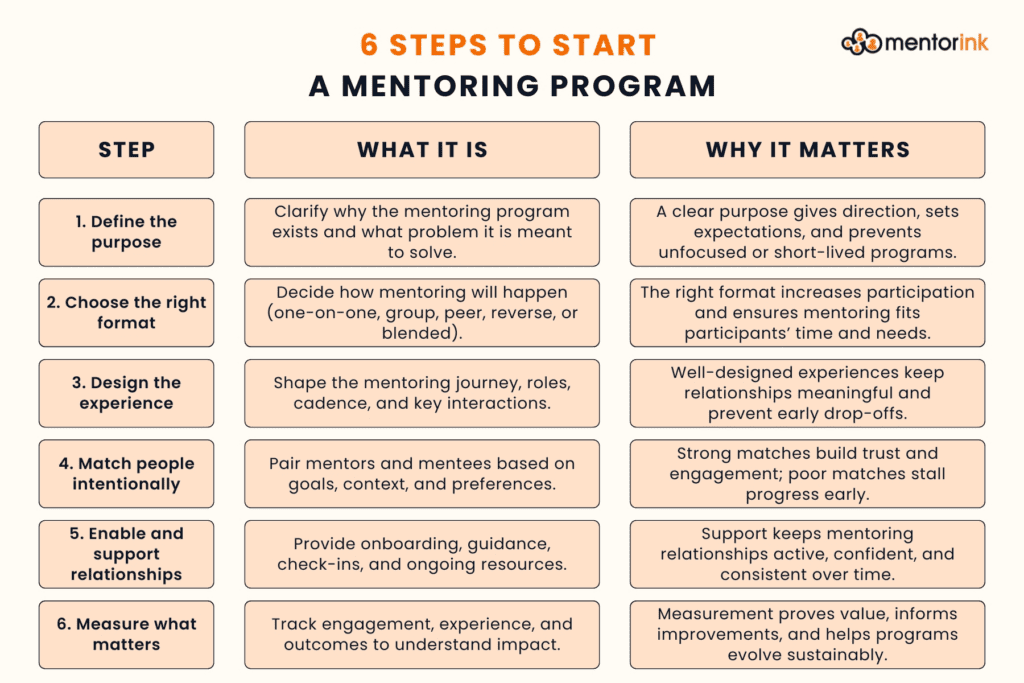
Step 1: Define the Purpose (Not Just the Program)
Every successful mentoring program starts with clarity. Before thinking about structure, tools, or timelines, it’s essential to understand why the program exists and what it is meant to change. Mentoring is not a goal on its own. It is a strategy to solve a specific problem and support a specific group.
Taking time to define the purpose of your mentoring program early on prevents common issues such as low engagement, unclear expectations, and outcomes that are difficult to explain or measure later. This step sets the foundation for all decisions that follow, from choosing the right format to evaluating impact.
Start with the real problem
Before choosing a mentoring format or inviting participants, clarify the actual problem you want mentoring to solve. Many programs start with good intentions but lack direction because the “why” is never clearly defined.
Common starting points include improving retention, supporting new hires, developing future leaders, strengthening inclusion, or increasing internal mobility. Mentoring can support all of these goals, but only if the purpose is clear from the beginning.
Why this matters:
When the purpose is vague, mentoring conversations become unfocused and engagement drops quickly. A clear problem gives the program direction and helps participants understand why their time and effort matter.
Define who the program is for
A mentoring program cannot be designed for everyone at once. Decide who will participate as mentees, who will act as mentors, and whether roles might evolve over time. The more specific the audience, the easier it becomes to design meaningful matches and relevant experiences.
Avoid being overly restrictive, but be intentional. A well-defined audience creates clarity for participants and prevents mismatched expectations.
Why this matters:
Clear participant definitions improve matching quality, increase commitment, and reduce confusion about roles and responsibilities.
Align mentoring goals with organizational needs
Mentoring should support broader organizational priorities rather than exist as a standalone initiative. Connect the program’s purpose to business or institutional goals such as leadership pipelines, onboarding efficiency, DEI efforts, or skills development.
This alignment also makes it easier to gain leadership support and justify long-term investment in the program.
Why this matters:
Programs that are aligned with organizational goals are more likely to receive ongoing support, resources, and visibility.
Decide what success should look like
You don’t need perfect metrics on day one, but you do need a shared understanding of success. Consider what should change as a result of the program. This could include improved engagement, clearer career paths, stronger internal networks, or measurable development outcomes.
Success can be both qualitative and quantitative, but it should always be intentional.
Why this matters:
Defining success early creates accountability and gives you a reference point for improving the program over time.
With a clear purpose in place, the foundation of your mentoring program is set. You now know why the program exists, who it is for, and what success should look like. The next step is turning that intention into action by deciding how mentoring will be delivered. This is where choosing the right mentoring format becomes critical.
The delicate balance of mentoring someone is not creating them in your own image, but giving them the opportunity to create themselves.
Steven Spielberg
Step 2: Choose the Right Mentoring Format
Once the purpose is clear, it’s time to decide how mentoring will actually work in practice. The right format makes mentoring easier to participate in, easier to manage, and easier to sustain over time.
When choosing a mentoring format, consider:
- Your primary goal: Leadership development, onboarding, skill-building, inclusion, or knowledge sharing all require different approaches.
- Your target audience: New hires, high-potentials, managers, students, or peer groups will engage differently with mentoring.
- Time availability: How much time can mentors and mentees realistically commit without creating fatigue?
- Program scale: A format that works for a small cohort may not work at organizational scale.
- Work environment: Fully remote, hybrid, or in-person teams need different levels of structure and support.
Common mentoring formats to choose from:
- One-on-one mentoring: Best for personalized development, leadership growth, and career guidance.
- Group mentoring: One mentor supporting multiple mentees, ideal for shared learning and efficient use of mentor time.
- Peer mentoring:Participants at similar levels learning from each other through collaboration and reflection.
- Reverse mentoring: Junior employees mentoring senior leaders, often around technology, culture, or emerging perspectives.
- Blended formats: Combining multiple formats within the same program to meet different needs.
For more details on mentoring formats and real-world use cases, you can explore our Mentoring Types Playbook.
Why this matters:
The mentoring format shapes the entire experience. When the format aligns with your purpose and participants’ realities, engagement increases and mentoring feels natural rather than forced. A poorly chosen format, even with strong intentions, can create friction, drop-offs, and inconsistent outcomes.
Once you’ve chosen the mentoring format that fits your goals and audience, the focus shifts from structure to experience. A strong format sets the frame, but what happens inside that frame determines whether mentoring relationships actually work.
Step 3: Design the Experience (Not Just the Structure)
A mentoring program is more than a timeline and a set of rules. It is an experience shaped by expectations, interactions, and ongoing support. Designing the experience means thinking about how mentors and mentees will move through the program from start to finish.
Define the mentoring journey
Outline what the mentoring relationship should look like over time. This includes when relationships begin, how they progress, and how they come to a close. A clear journey helps participants understand where they are and what comes next.
Why this matters:
Without a defined journey, mentoring often loses momentum after the first few meetings.
Set clear roles and expectations
Clarify what is expected from mentors and mentees. This includes time commitment, meeting cadence, preparation, and boundaries. Clear expectations reduce uncertainty and prevent mismatched assumptions.
Why this matters:
When roles are unclear, even motivated participants may disengage or feel frustrated.
Decide on cadence and duration
Determine how often mentoring sessions should take place and how long the relationship will last. Some programs work best with monthly sessions over a year, while others benefit from shorter, more focused cycles.
Why this matters:
A realistic cadence keeps mentoring sustainable and prevents burnout.
Support the first interactions
The first meetings set the tone for the entire relationship. Providing guidance, prompts, or simple frameworks can help mentors and mentees start strong and build trust early.
Why this matters:
Strong starts lead to stronger relationships and higher long-term engagement.
Plan for closure and reflection
Mentoring relationships should not simply fade out. Build in a clear ending that encourages reflection, learning, and next steps for mentees.
Why this matters:
Intentional closure reinforces the value of the experience and increases the likelihood of continued development.
Once the mentoring experience is designed, the next critical question is simple: who should mentor whom? Even the best-designed programs struggle if the right people are not paired together.
Step 4: Match People Intentionally
Matching is the backbone of any mentoring program. It directly influences trust, engagement, and long-term success. Poor matches lead to stalled conversations and early drop-offs, while thoughtful matching creates momentum from the very first meeting.
Rather than treating matching as an administrative task, approach it as a strategic decision.
What to consider when matching mentors and mentees
- Development goals: What does the mentee want to learn or achieve, and what experience can the mentor realistically offer?
- Experience and context: Seniority, functional background, and industry knowledge all shape the quality of the relationship.
- Interests and working styles: Shared interests or compatible communication styles often lead to stronger connections.
- Availability and capacity: A great match only works if both parties have the time and energy to commit.
Decide how matching will happen
There is no single right approach. The key is choosing a method that fits your program size and level of control.
- Manual matching: Program owners manually pair mentors and mentees based on their knowledge of participants. This works best for small, highly curated programs where the coordinator knows people well.
- Software-supported matching (admin-led): Program owners define the matching criteria, and software helps generate optimal matches at scale. This approach balances control with efficiency and is ideal for growing or structured programs.
- Software-supported matching (user-led): Participants browse profiles and choose their own mentors or mentees within defined boundaries. This increases ownership and motivation while still operating within a structured system.
Allow flexibility and feedback
No matching process is perfect. Build in opportunities for feedback, adjustments, or re-matching when necessary. This shows participants that the program is designed to support them, not trap them in unproductive relationships.
Why this matters:
The quality of mentor–mentee matches shapes everything that follows. Intentional matching increases trust, accelerates progress, and reduces early disengagement. When people feel well-matched, they are far more likely to stay committed and invested in the mentoring relationship.
Once mentors and mentees are matched, the real work begins. Even strong matches need guidance and support to turn good intentions into meaningful progress.
Step 5: Enable & Support the Relationship
Mentoring relationships don’t thrive on good intentions alone. Ongoing guidance and light-touch support help participants stay engaged and move forward together.
To enable and support mentoring relationships:
- Prepare participants before the first meeting: Set clear expectations around roles, time commitment, and goals so mentors and mentees start with confidence.
- Support early conversations: Provide simple agendas, conversation starters, or goal-setting prompts to help pairs move beyond small talk.
- Encourage consistency, not rigidity: Recommend a meeting cadence while allowing flexibility based on participants’ schedules and needs.
- Offer ongoing guidance and resources: Share tips, reflection prompts, or learning materials that align with different stages of the mentoring journey.
- Create space for feedback and check-ins: Make it easy for participants to raise concerns, ask for help, or adjust the relationship if needed.
Why this matters:
Without support, mentoring relationships often lose momentum or fade out quietly. Consistent enablement keeps relationships active, builds trust in the program, and helps mentoring deliver real value for both mentors and mentees.
With mentoring relationships supported and moving forward, the final step is understanding whether the program is delivering the outcomes it was designed for.
Step 6: Measure What Matters
Measuring a mentoring program is not about tracking activity for the sake of reporting. It’s about understanding what’s working, what’s not, and how the program contributes to meaningful outcomes.
Focus on three key measurement areas:
- Engagement
- Are mentoring sessions actually happening?
- How consistently do mentors and mentees meet?
- Where do drop-offs occur?
- Progress and experience
- Do participants feel supported and challenged?
- Are mentoring goals being defined and revisited?
- What qualitative feedback are mentors and mentees sharing?
- Outcomes and impact
- Are there signs of growth, development, or increased confidence?
- Does the program support retention, mobility, onboarding, or leadership development goals?
- Are participants more connected to the organization?
Use measurement to improve, not control
- Treat data as a learning tool, not a performance scorecard
- Look for patterns rather than isolated data points
- Adjust matching criteria, guidance, or structure based on insights
- Share outcomes with stakeholders to build long-term support
Why this matters:
Programs that are not measured tend to stagnate or disappear. Measuring what matters helps you prove value, improve the experience over time, and ensure your mentoring program continues to evolve alongside your organization.
From insight to action:
Measurement is only valuable if it leads to better decisions. Insights from engagement, experience, and outcomes should inform how you refine your mentoring formats, matching approach, and ongoing support. This is where structure, data, and experience come together.
How Mentorink Can Help
Building a mentoring program takes more than good intentions. Mentorink helps you turn insight into action by supporting every stage of the mentoring journey, from design to delivery and improvement, without overcomplicating the experience.
What you can do with Mentorink
- Design flexible mentoring programs: Support one-on-one, group, peer, or reverse mentoring with structures that fit your goals.
- Match participants intentionally: Use manual, admin-led, or user-led matching to balance control, scale, and participant ownership.
- Support mentoring relationships: Guide mentors and mentees with clear journeys, prompts, and light-touch check-ins.
- Understand what’s working: Track engagement and outcomes to continuously improve your mentoring program.
Key Takeaways
- Start with purpose, not structure.
- Choose a mentoring format that fits your goals and participants.
- Design the mentoring experience, not just the timeline.
- Match people intentionally, not randomly.
- Support relationships with light structure and ongoing guidance.
- Measure what matters and use insights to continuously improve.
Frequently Asked Questions
How long does it take to start a mentoring program?
A mentoring program can be launched in a few weeks if the purpose, audience, and format are clear. More complex or large-scale programs may take longer to design and roll out.
What is the best mentoring format to start with?
There is no single best format. One-on-one mentoring works well for personalized development, while group or peer mentoring is better for shared learning and scalability. The right choice depends on your goals and participants.
Do mentoring programs need software?
Small programs can run manually, but as programs grow, software helps with matching, guidance, communication, and measurement. It reduces admin workload and improves consistency.
How do you keep mentoring relationships active?
Clear expectations, regular check-ins, simple guidance, and ongoing support help mentoring relationships stay engaged and productive over time.
How do you measure the success of a mentoring program?
Success can be measured through engagement, participant feedback, and outcomes such as development progress, retention, or internal mobility, depending on the program’s goals.