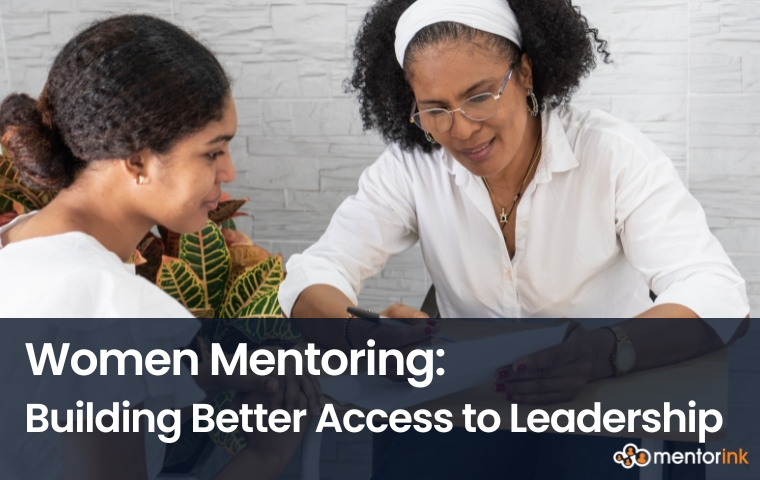
Women mentoring is not about telling women to be more confident, more visible or more ambitious. Many already are.
The real question is whether women have equal access to the mentors, networks, sponsors and leadership conversations that help careers move forward.
And access is still uneven. According to DDI’s 2024 data, only 24% of women leaders have had a formal mentor, compared to 30% of men. This may look like a small gap at first, but it points to a bigger issue: career growth is not shaped by performance alone.
People grow when they receive feedback, see possible paths, build the right relationships and get support before key opportunities appear. A strong women mentoring program creates that access more intentionally.
For organizations, this makes women mentoring more than a supportive initiative. It becomes a practical way to strengthen leadership development, improve retention and build more inclusive talent pipelines.
What Is Women Mentoring?
Women mentoring is a mentoring relationship or program designed to support women’s career growth, leadership development and access to opportunity.
It can happen informally, through a trusted colleague, manager or professional connection. Or it can be formal, with clear goals, matching criteria, timelines, training and feedback.
The formal side matters. In a 2013 DDI study, 63% of women reported that they had never had a formal mentor. When mentoring is left to informal networks alone, the people who already know how to access support are usually the ones who benefit most.
A women mentoring program changes that. It creates a more intentional way for women to discuss career goals, workplace challenges, visibility, communication, networking and leadership.
It can include women-to-women mentoring, peer mentoring, group mentoring, reverse mentoring or relationships with male allies and senior sponsors. The format may change, but the purpose stays the same: helping women access the guidance, perspective and opportunities that support long-term growth.
Strong women mentor others to be even stronger
Why Women Mentoring Matters in the Workplace
Women mentoring matters because career growth is not only about doing good work. It is also about being seen, included and supported before opportunities appear.
In many organizations, the most valuable career conversations do not always happen in formal reviews. They happen through networks, recommendations, stretch assignments, sponsorship and informal guidance.
When women have less access to those spaces, progression can become harder even when performance is strong.
Mentoring helps make that access more intentional. It gives women a space to ask questions, understand career paths, receive honest feedback and prepare for leadership opportunities with more clarity.
For organizations, this is not just about individual development. Women mentoring can help retain high-potential talent, strengthen succession pipelines and build a more diverse group of future leaders.
That is why women mentoring should not sit on the side of talent strategy. It should be part of how organizations develop, support and promote their people.
Benefits of Women Mentoring
The real value of women mentoring is that it turns hidden career support into something more visible, accessible and repeatable.
Instead of leaving growth to informal networks, women mentoring creates a structure where women can access the guidance, feedback and opportunities that help careers move forward. Key benefits include:
- Clearer career direction: Mentoring helps women understand where they want to go, what options are available and what steps can move them closer to their goals.
- Better access to networks: A mentor can help open doors to people, conversations and perspectives that may not be easy to reach alone.
- More visibility: Mentoring can help women communicate their work, build internal relationships and become better known for their strengths and potential.
- Stronger self-advocacy: Mentors can help mentees prepare for promotion conversations, salary discussions, leadership opportunities and moments where they need to speak up for themselves.
- More honest feedback: A good mentoring relationship creates space for feedback that is practical, direct and focused on growth.
- Leadership readiness: Women mentoring helps participants build the confidence, communication skills and strategic thinking needed for future leadership roles.
- Higher retention: When women see a path forward and feel supported in their growth, they are more likely to stay and continue developing within the organization.
For organizations, these benefits connect directly to stronger talent pipelines. Women mentoring helps turn development from something informal and uneven into something intentional and measurable.
Benefits of Women-to-Women Mentoring
Women mentoring does not always have to be women-to-women, but women-to-women mentoring can create a different kind of trust.
This matters because some career conversations are easier when the other person has seen similar rooms, expectations and barriers before. Key benefits include:
- Shared context: A woman mentor may understand certain workplace situations from lived experience, such as being the only woman in a meeting, navigating bias or building authority in a male-dominated environment.
- More honest conversations: Shared experience can make it easier to talk about topics like boundaries, confidence, visibility, work-life expectations or difficult workplace dynamics.
- Stronger role modeling: Seeing another woman lead, grow and make decisions can help mentees imagine their own path more clearly.
- Less isolation: Women-to-women mentoring can create a stronger sense of belonging, especially in teams, industries or leadership groups where women are underrepresented.
- Growth for mentors too: Mentoring is not only valuable for the mentee. Women mentors also strengthen their leadership, listening, coaching and communication skills through the relationship.
Women-to-women mentoring is powerful because it combines practical career support with lived experience. It gives women a space to learn from someone who may not have the exact same journey, but who understands parts of the road.men a space to learn from someone who may not have the same journey, but who understands parts of the road.
There is no limit to what we, as women, can accomplish.
Michelle Obama
How to Build an Effective Women Mentoring Program
A women mentoring program should not be a regular mentoring program with a different name. It needs to be designed around access: access to guidance, visibility, networks, sponsorship and leadership opportunities.
Here are the key steps:
- Start with the real barriers: Before designing the program, identify what is slowing women’s progression in your organization. Is it limited access to senior leaders? Low visibility? Weak succession pipelines? Fewer sponsorship opportunities? The program should respond to real needs, not assumptions.
- Connect the program to leadership goals: Women mentoring works best when it is tied to clear outcomes. For example, the goal may be to prepare more women for management roles, retain high-potential women, support women in technical teams or strengthen gender diversity in succession planning.
- Match for goals, context and access: Matching should go beyond department or seniority. Consider each mentee’s goals, career stage, lived context and the kind of access they need. Some may need strategic guidance. Some may need visibility. Some may need a mentor who understands their specific workplace challenges.
- Include allies and sponsors: Women-to-women mentoring can be powerful, but the responsibility should not sit only with women. Male allies, senior leaders and sponsors can also help mentees access networks, opportunities and leadership conversations.
- Measure what changes: Do not only track how many people joined. Measure whether participants gained career clarity, stronger networks, leadership readiness, internal mobility, retention or promotion opportunities.
The most effective women mentoring programs do not ask women to simply adapt to existing systems. They create structured support, better access and clearer development pathways so women can grow with more visibility and confidence.
How Mentorink Supports Women Mentoring Programs
Women mentoring programs need structure to create real impact. Without clear goals, thoughtful matching and regular follow-up, mentoring can quickly become uneven. Some participants get strong support, while others are left guessing what to do next.
Mentorink helps organizations turn women mentoring into a structured, scalable and measurable development experience.
With Mentorink, HR and L&D teams can:
- Build programs around goals such as leadership development, retention, career progression, DEI or employee engagement
- Manage applications, participant profiles, matching, communication, feedback and reporting from one platform
- Match mentors and mentees based on goals, skills, preferences and program criteria
- Support participants with goal-setting and progress tracking
- Collect feedback and monitor engagement throughout the program
- Measure outcomes such as career clarity, stronger networks, leadership readiness and long-term development
For women mentoring programs, this visibility matters. It helps organizations see whether the program is actually creating access, not just assigning mentoring pairs.
Whether the goal is to support women in leadership, improve retention or build a more inclusive development culture, Mentorink helps make mentoring easier to manage and easier to measure.
FAQs About Women Mentoring
Why are informal networks not enough for women’s career growth?
Informal networks often benefit the people who already know how to navigate them. When mentoring depends only on personal relationships, some employees get more access to advice, visibility and sponsorship than others. Structured women mentoring programs make development support more intentional and more equal.
Does women mentoring have to be women-to-women?
No. Women-to-women mentoring can be very powerful because shared experiences often create trust and openness. However, women mentoring programs can also include male mentors, allies and sponsors, especially in organizations where senior leadership is still male-dominated.
The goal is not to make women responsible for solving gender equity on their own. The goal is to create better access to guidance, networks and opportunities across the organization.
Should men be part of women mentoring programs?
Yes. Women-to-women mentoring can create trust and shared understanding, but men should also be part of the solution. Male allies, senior leaders and sponsors can help women access networks, leadership conversations and opportunities, especially in organizations where senior roles are still male-dominated.
How can organizations avoid making women mentoring performative?
Women mentoring becomes performative when it is launched without clear goals, structure or follow-up. To avoid this, organizations should define what barrier the program is solving, match participants intentionally, involve leadership and measure outcomes beyond participation numbers.
What is the biggest mistake companies make with women mentoring?
The biggest mistake is treating it like a regular mentoring program with a gender label. A women mentoring program should be designed around the specific access gaps women may face, including visibility, sponsorship, senior networks and leadership opportunities.