Mentoring is often seen as a natural next step in employee development. Its long-term impact can be significant. According to Harvard Business Review, 89% of mentees go on to become mentors themselves. When organizations want to improve engagement, strengthen leadership pipelines, or support inclusion, mentoring quickly becomes part of the conversation.
But mentoring is not always the right solution.
Before launching a program, leaders responsible for talent and development across corporate, nonprofit, and educational organizations need to pause and ask a more strategic question: Is mentoring the most effective intervention for the challenge we’re trying to solve, or would training, coaching, or another development approach be more appropriate?
Too often, mentoring programs are introduced because they sound valuable, not because they are aligned with a clearly defined need. Without alignment, even well-intentioned initiatives struggle to gain traction, deliver measurable impact, or sustain long-term engagement.
This article is not about how to start a mentoring program. It’s about what you should evaluate before deciding to launch one. Because the success of a mentoring program doesn’t begin with matching participants.
It begins with clarity.
Is Mentoring the Right Solution for Your Organization?
Launching a mentoring program should never be the first reaction to a development challenge. It should be the result of a clear and thoughtful diagnosis. When organizations face issues such as low engagement, leadership gaps, or retention concerns, mentoring often appears to be a natural solution.
However, mentoring is not a universal fix. It is one of several development interventions available to mentoring program managers. Before moving forward, it is essential to step back and examine the root cause of the issue you are trying to solve. Without this clarity, even well-intentioned initiatives can struggle to deliver meaningful and measurable impact.
What Is the Real Problem?
Before discussing formats or structures, clarify the specific challenge your organization is trying to address. Mentoring can be a powerful tool, but only when it responds to a clearly defined need. At this stage, the focus should not be on designing a program. The focus should be on diagnosing the real issue.
Ask yourself:
- Is voluntary turnover increasing within a specific employee group?
- Are high-potential employees lacking exposure to leadership or strategic projects?
- Is critical knowledge concentrated within a small number of senior employees?
- Are succession plans unclear or underdeveloped?
- Are underrepresented groups facing barriers to advancement?
- Are new hires struggling to integrate into the organization?
- Are employees asking for more career guidance and internal mobility opportunities?
If the answers point to long-term development, career navigation, or relationship-based growth, mentoring may be appropriate. If the issue is primarily technical skill gaps or compliance-related knowledge, other interventions may be more effective.
Clarity at this stage prevents misaligned expectations later.
Mentoring, Training, or Coaching?
Not every development challenge requires mentoring. The right intervention depends on the nature of the problem you are trying to solve.
Use this simple decision lens:
- Training: If the goal is to build specific technical skills, standardize knowledge, or ensure compliance across a group.
- Coaching: If the focus is on targeted behavioral change, performance improvement, or leadership effectiveness for an individual.
- Mentoring: If the objective involves long-term career development, knowledge transfer, organizational navigation, exposure, or relationship-based growth.
Each approach serves a different purpose. Clarity at this stage ensures you invest in the intervention that best supports your desired outcome.
Simply put, coaching is where you work with someone to connect with yourself, redesign your environment and your life, and then take action to implement it!
Emma-Louise Elsey
Is This a Trend or a Strategic Need?
Mentoring has gained significant visibility in recent years. Many organizations introduce mentoring programs because peers are doing so or because mentoring aligns with broader talent development trends.
However, external momentum is not the same as internal readiness.
Before moving forward, it is important to evaluate whether the initiative is grounded in a clearly defined organizational need. Consider whether the program is directly connected to a measurable business objective, whether there is evidence that mentoring addresses the specific challenge at hand, and whether the organization is responding to a genuine development gap rather than pressure to implement a program.
Initiatives driven primarily by trend often struggle to maintain long-term commitment. Programs rooted in strategic need are far more likely to sustain engagement and deliver meaningful impact.
Do You Have Leadership Commitment?
A mentoring program requires more than interest. It requires visible and sustained leadership commitment. Without alignment at the top, even well-designed initiatives struggle to gain credibility and participation.
Executive Sponsorship
Mentoring programs need a clear sponsor at the leadership level. A visible executive advocate signals that the program is not just an HR initiative but a strategic priority. Sponsorship ensures accountability, visibility, and cross-functional support.
Budget
A successful program requires financial clarity. Consider whether there is allocated budget for:
- Program management and administration
- Training or orientation sessions
- Mentoring software or tools
- Measurement and reporting
- Communication and internal promotion
Without defined resources, programs often operate in a reactive mode.
Time Allocation
Mentoring requires time. Both mentors and mentees must be able to commit to regular conversations without feeling that participation conflicts with performance expectations.
Evaluate whether mentoring time is formally supported within workloads or treated as an informal extra responsibility.
Manager Support
Direct managers play a critical role in program success. If managers do not actively support participation, employees may hesitate to prioritize mentoring sessions.
Alignment questions to consider:
- Do managers understand the purpose of the program?
- Are they willing to protect time for participation?
- Do they see mentoring as part of development, not a distraction from productivity?
Leadership commitment is not only about approval. It is about active endorsement and structural support.
Is Your Organization Ready for Mentoring?
Mentoring is built on relationships. If the cultural foundation is weak, even well-structured programs struggle to gain traction. Before launching, assess whether your organization provides the right environment for mentoring to thrive.
Evaluate the following conditions:
- Psychological safety: Employees feel comfortable discussing challenges, mistakes, and development areas without fear of negative consequences.
- Trust: There is mutual respect across teams and hierarchy levels, allowing open and honest dialogue.
- Feedback culture: Constructive feedback is normal, expected, and part of everyday work conversations.
- Cross-level communication: Junior and senior employees can interact without excessive hierarchy or formality barriers.
- Growth mindset: Development and learning are valued alongside performance and results.
- Knowledge-sharing norms: Senior employees are willing to share experience and insights without defensiveness or gatekeeping.
- Manager openness: Direct managers encourage participation in development initiatives rather than prioritizing short-term output only.
If several of these elements are missing, mentoring relationships may struggle to build trust and momentum. Cultural readiness often determines long-term sustainability more than program design itself.
Do You Have Enough Mentor Capacity?
One of the most overlooked risks in mentoring programs is capacity. Organizations often focus on recruiting mentees and generating excitement, but underestimate the availability and sustainability of their mentor pool.
Mentor capacity is not just about numbers. It is about readiness, bandwidth, and long-term commitment. Without realistic planning, even well-intentioned mentors can become overwhelmed, which directly impacts engagement and program credibility.
Mentor Pool
Start by assessing the depth and diversity of your potential mentor pool.
Do you have enough experienced professionals who are both willing and suitable to mentor others? Is expertise concentrated within a small group of senior leaders, or is there a broader base of employees who can contribute? A limited mentor pool often leads to repeated reliance on the same individuals, reducing program scalability.
A healthy mentor pool includes not only senior leaders but also mid-level professionals with relevant expertise. Sustainable mentoring programs distribute responsibility rather than centralize it within a few visible figures.
Bandwidth
Even the most capable mentors need time and mental space to engage meaningfully.
Consider current workloads, performance expectations, and existing responsibilities. If mentoring is perceived as an additional task on top of already demanding roles, participation may feel burdensome rather than developmental.
Mentoring requires preparation, thoughtful conversation, and follow-up. Without protected time, interactions may become inconsistent or superficial. Capacity planning should account for realistic time commitments rather than ideal scenarios.
Risk of Mentor Burnout
Mentor burnout is rarely discussed, yet it is one of the fastest ways to weaken a program.
When a small group of high-performing leaders are repeatedly asked to mentor multiple participants, enthusiasm can quickly turn into fatigue. Over time, this leads to declining quality of conversations, reduced availability, and eventual withdrawal from the program.
Sustainable mentoring programs monitor mentor load, rotate responsibilities when possible, and ensure participation remains voluntary and supported. Long-term success depends on maintaining mentor motivation as much as mentee engagement.
Are You Clear on What Success Looks Like?
Many mentoring programs begin with enthusiasm but without a shared definition of success. When expectations are unclear, measuring impact becomes difficult and leadership confidence declines over time.
Before launching, clarity around outcomes is essential.
Success Definition
Start by defining what “success” actually means for your organization.
Success might include:
- Improved retention within a specific employee group
- Stronger leadership pipeline readiness
- Increased internal mobility
- Higher employee engagement scores
- Greater visibility for underrepresented talent
- Improved onboarding integration
A vague objective such as “support development” is not enough. Clear success criteria provide direction for participants and accountability for program owners.
Measurement Readiness
Once success is defined, determine whether you are prepared to measure it.
Consider whether you have:
- Baseline data before program launch
- Defined key metrics aligned with business goals
- Tools to track participation and engagement
- A method to collect qualitative feedback
- Internal resources to analyze results
Without measurement readiness, even positive outcomes may remain invisible.
Reporting Expectations
Finally, clarify how results will be communicated.
Leadership will eventually ask:
- Is the program delivering impact?
- What has improved as a result?
- Should we continue investing in this initiative?
Being prepared with structured reporting strengthens credibility and ensures the program is seen as a strategic investment rather than a temporary initiative.
Clear expectations around success and measurement protect the program from fading after initial enthusiasm.
Are You Prepared for Common Risks?
Even well-intentioned mentoring programs face predictable challenges. Anticipating these risks early allows you to design preventive measures rather than reacting once engagement declines.
Consider whether you are prepared for the following:
Low engagement
Initial enthusiasm does not guarantee sustained participation. Without clear expectations, structured follow-up, and visible leadership support, mentoring sessions may become irregular or postponed. Engagement must be actively maintained, not assumed.
Participant drop-offs
Some mentoring pairs naturally lose momentum. Competing priorities, lack of chemistry, or unclear goals can lead to silent disengagement. Programs should normalize re-matching or structured check-ins rather than treating drop-offs as failure.
Poor matching quality
Matching based solely on hierarchy or availability can weaken trust from the start. When expertise, goals, and communication styles are not aligned, conversations often remain surface-level. Matching quality significantly influences program credibility.
Role confusion
Mentors are not managers, therapists, or sponsors by default. Mentees are not passive recipients of advice. Without clearly defined roles and boundaries, expectations can quickly become misaligned, leading to frustration on both sides.
Over-reliance on a few mentors
A small group of highly visible leaders often carries a disproportionate mentoring load. Over time, this creates fatigue and limits scalability. Capacity planning and rotation are essential for sustainability.
Lack of visible outcomes
If progress is not measured or communicated, stakeholders may question the program’s value. Even successful mentoring relationships can lose organizational support if results are not translated into clear impact narratives.
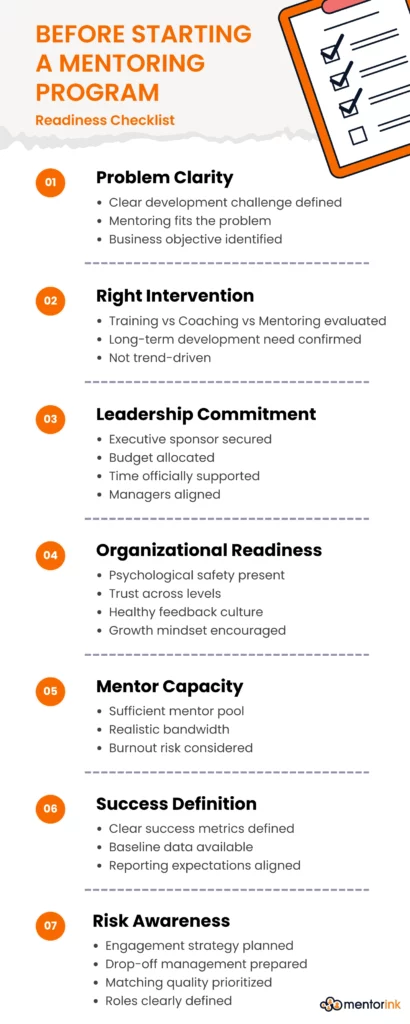
Preparing for these risks does not guarantee perfection. It demonstrates maturity. Programs that anticipate challenges are far more resilient than those that assume smooth execution.
Conclusion
Starting a mentoring program is a strategic decision, not an automatic next step. When the underlying need is clear, leadership is committed, capacity is realistic, culture is supportive, and success is defined, mentoring can become a powerful driver of long-term development.
If these conditions are in place, you are ready to move forward.
To understand how to structure, launch, and sustain a mentoring program effectively, explore our latest guide: How to Start a Mentoring Program That Actually Works (2026 Update).
Clarity first. Then action.