
Healthcare is one of those sectors where learning never really stops. A new role, a difficult conversation, a complex patient case, a fast-changing team, there is always something that requires more than what formal training can cover. And often, the most valuable lessons do not come from a handbook. They come from someone who has been there before.
That is where mentoring in healthcare becomes powerful. In a field shaped by high workloads, emotional responsibility, strict standards, and constant change, mentoring gives healthcare professionals a structured way to learn from experience, ask better questions, and grow with more confidence.
A strong healthcare mentoring program does not replace formal education, clinical supervision, or compliance training. It supports them. It helps organizations turn everyday experience into shared knowledge, stronger professional relationships, and more sustainable development.
Importance of Mentoring in Healthcare
In healthcare, professional growth does not happen only through formal training. It also happens in the moments where people need judgment, confidence, and context.
That is why mentoring in healthcare is not just a nice extra. It helps professionals learn from experience, feel supported in demanding roles, and build the kind of practical knowledge that is difficult to capture in manuals.
Why Mentoring Matters in Healthcare
Some of the most important lessons in healthcare come from real situations: a difficult patient conversation, a complex case, a busy shift, or a moment where good judgment matters.
A structured healthcare mentoring program helps this knowledge move from experienced professionals to those still growing in their roles.
It can support onboarding, patient communication, ethical decision-making, career direction, leadership development, and retention. More importantly, it gives organizations a reliable way to support people before small challenges become bigger problems.
How to Build a Successful Healthcare Mentoring Program
A successful healthcare mentoring program needs to fit the way healthcare actually works. Busy schedules, clinical responsibility, hierarchy, confidentiality, and emotional pressure all affect how mentoring relationships should be designed.
To make mentoring work in healthcare, organizations should focus on:
- Start with a healthcare-specific goal: Define whether the program is supporting residents, newly qualified nurses, clinical confidence, leadership readiness, onboarding, retention, or cross-functional collaboration.
- Match around real healthcare context: Do not match people only by availability. Consider specialty area, department, career stage, clinical interests, patient-facing experience, development needs, location, and shift patterns.
- Prepare mentors for sensitive conversations: Healthcare mentors may need to support mentees through uncertainty, difficult cases, patient communication challenges, burnout signals, or confidence issues. They should know how to guide without turning mentoring into supervision or assessment.
- Separate mentoring from clinical supervision: This is especially important in healthcare. Mentees should understand that mentoring is a safe development space, not a performance review, compliance check, or formal evaluation process.
- Make the structure realistic for healthcare schedules: Long, frequent meetings may not work for busy clinical teams. Monthly check-ins, short reflection prompts, and flexible scheduling can help mentoring stay consistent without adding pressure.
- Protect trust in hierarchical environments: Junior professionals may hesitate to speak openly if they fear judgment. Clear confidentiality rules and psychological safety should be built into the program from the beginning.
- Give program managers visibility without over-monitoring: Healthcare organizations need to know whether mentoring relationships are active, especially across departments, hospitals, or cohorts. The goal is not to control conversations, but to spot where support is needed.
This is what turns mentoring in healthcare from informal advice into a reliable development practice that supports professionals in the moments where guidance matters most.
When mentoring is structured well, its impact goes beyond individual growth. It helps healthcare organizations strengthen confidence, collaboration, leadership continuity, and knowledge transfer before valuable experience stays hidden or leaves the organization.
Benefits of Mentoring in Healthcare
The benefits of mentoring in healthcare are not limited to individual career growth. In a sector where experience, judgment, communication, and trust matter every day, mentoring helps knowledge move more intentionally across roles, teams, and career stages.
Benefits of Mentoring for Mentors in Healthcare
For healthcare mentors, mentoring is not only about “giving advice.” It is a way to strengthen their own practice while helping others navigate the realities of clinical and organizational life. Key benefits include:
- Stronger clinical leadership: Mentors practice guiding others through real healthcare challenges, from patient communication to complex decision-making and team coordination.
- More reflective practice: Supporting a mentee often encourages experienced professionals to reflect on their own judgment, habits, communication style, and leadership approach.
- Better knowledge transfer: Mentors can pass on practical insight that is rarely captured in formal training, such as how to handle pressure, manage difficult conversations, or understand team dynamics.
- Renewed sense of purpose: Helping another professional grow can reconnect mentors with the human side of healthcare, especially in environments where workload and pressure can make development feel secondary.
Benefits of Mentoring for Mentees in Healthcare
For mentees, healthcare mentoring provides support that is grounded in real clinical and organizational experience. It helps them understand not only what to do, but how to think, communicate, and grow in a demanding healthcare environment. Key benefits include:
- Confidence in real healthcare situations: Mentees can feel more prepared when facing complex cases, difficult patient conversations, new responsibilities, or unfamiliar team dynamics.
- Stronger clinical and professional judgment: A mentor can help mentees reflect on decisions, understand context, and learn how experienced professionals approach uncertainty.
- Faster adaptation to healthcare environments: New employees, residents, junior clinicians, and newly qualified nurses can better understand workflows, expectations, patient care standards, and team culture.
- Better patient communication: Mentoring can help mentees learn how to communicate with patients and families more clearly, calmly, and empathetically.
- Clearer career direction in healthcare: Mentees can explore possible paths, specialties, leadership opportunities, or next steps with someone who understands the sector.
Benefits of Mentoring for Organizations in Healthcare
For healthcare organizations, mentoring creates a more reliable way to support people in roles where experience, judgment, and continuity matter every day. Key benefits include:
- Better retention in high-pressure roles: When healthcare professionals feel supported and connected, they are more likely to stay engaged and see a future within the organization.
- Faster onboarding for new healthcare professionals: New employees, residents, nurses, clinicians, and healthcare administrators can adapt more quickly with guidance from people who understand the environment.
- More consistent professional development: Mentoring helps development become less dependent on informal relationships, individual managers, or chance encounters with supportive colleagues.
- More inclusive access to guidance: Structured mentoring makes support more visible and accessible across roles, departments, backgrounds, and career stages.
- A stronger culture of support: Mentoring reinforces learning, trust, shared responsibility, and professional care within the organization.
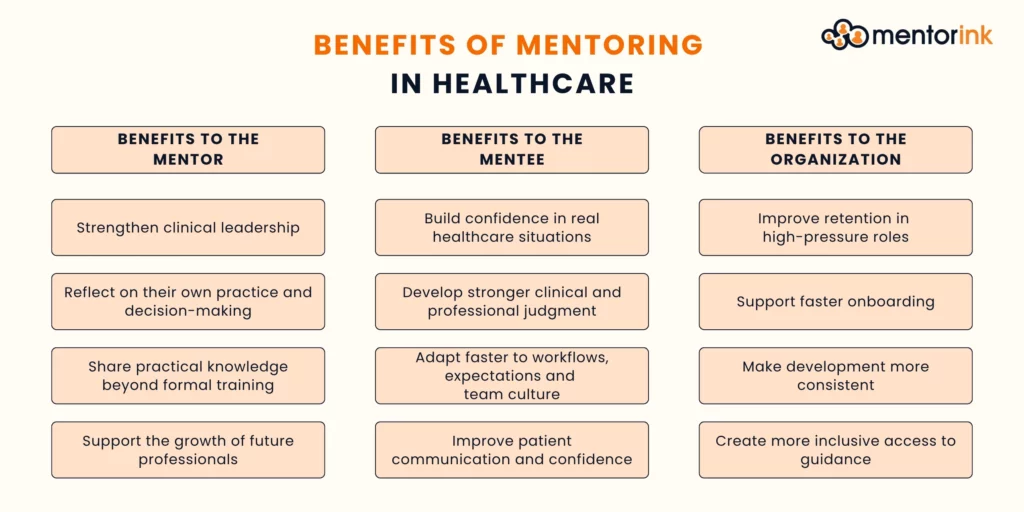
When these benefits come together, mentoring becomes more than a development activity. It becomes part of how healthcare organizations protect knowledge, support their people, and build stronger teams over time.
Challenges and Opportunities in Healthcare Mentoring
Healthcare mentoring programs often face a very practical challenge: people want support, but they do not always have time for another complicated process.
Busy schedules, shift work, limited mentor availability, hierarchy, and compliance expectations can all make mentoring harder to sustain. In larger healthcare organizations, dispersed teams and multiple departments can also make it difficult to see whether mentoring relationships are actually active. But these challenges are also where structured mentoring becomes useful.
A healthcare mentoring program can work better when it is designed around real constraints:
- Busy schedules: Keep meetings realistic, flexible, and easy to maintain.
- Shift-based work: Allow mentoring pairs to choose rhythms that fit their availability instead of forcing one fixed format.
- Hierarchy: Make confidentiality and psychological safety clear from the beginning, especially for junior professionals.
- Limited mentor availability: Use group mentoring or peer mentoring when one-to-one capacity is limited.
- Dispersed teams: Use digital coordination, reminders, and reporting to keep the program visible across departments or locations.
- Measuring impact: Track participation, feedback, and progress without interfering with private mentoring conversations.
When these challenges are addressed intentionally, mentoring in healthcare becomes easier to sustain. It can move from informal support to a reliable development practice that helps professionals feel guided, connected, and better prepared for the realities of healthcare work.
Mentoring Models for Healthcare Organizations
The right mentoring model depends on what the healthcare organization wants to support: clinical confidThe right mentoring model depends on the problem the healthcare organization is trying to solve. A program designed to support residents will not need the same structure as one focused on nurse leadership, onboarding, or collaboration between clinical and administrative teams. Instead of starting with the format, organizations should start with the need.
- Specialist-to-junior mentoring works well when the goal is to support clinical judgment, confidence, patient communication, and career direction for residents, junior doctors, or early-career clinicians.
- Onboarding mentoring is useful when new healthcare employees need help understanding workflows, patient care expectations, internal systems, and the culture of a specific healthcare environment.
- Peer mentoring can support residents, nurses, or early-career professionals who are facing similar pressures. It is especially useful for reducing isolation and encouraging shared reflection.
- Leadership mentoring fits organizations that want to prepare future nurse managers, department heads, clinical leaders, or operational leaders. It can focus on decision-making, team coordination, conflict management, and leading under pressure.
- Coaching and mentoring in healthcare often overlap. A review of mentorship in the health professions notes that mentoring involves both a coaching and an educational role, combining guidance, skill development, reflection, and knowledge sharing. This can be especially useful for professionals preparing for new responsibilities, improving communication, or building confidence in complex healthcare environments.
- Cross-functional mentoring supports collaboration between clinical, operational, and administrative teams. It can help reduce communication gaps and improve understanding across roles that need to work closely together.
Choosing the right model helps healthcare organizations avoid generic mentoring. A resident may need clinical guidance, a new nurse may need help adapting to daily workflows, and a future department leader may need space to build leadership judgment. The strongest programs begin with that difference.
The strongest healthcare mentoring programs are designed around these specific needs, not around a generic mentoring format. This makes the program easier to explain, easier to manage, and more valuable for the people taking part.
Best Practices for Running Healthcare Mentoring Programs
A healthcare mentoring program may be well designed, but it still needs the right habits to stay active. In a busy environment, the real challenge is not only launching the program. It is keeping mentoring consistent after the first match is made.
Key best practices include:
- Keep the meeting rhythm realistic: Monthly or bi-monthly check-ins are often easier to sustain than frequent meetings, especially for shift-based teams.
- Give participants simple conversation prompts: Short guides can help mentors and mentees discuss clinical confidence, patient communication or career direction without making the relationship feel scripted.
- Make scheduling easy: Healthcare professionals may work across shifts, departments, or locations. Flexible scheduling and reminders can help mentoring stay active.
- Check engagement without entering private conversations: Program managers should know whether meetings are happening and where support is needed, while still respecting confidentiality.

- Support mentors during the program: Mentors may need guidance if a mentee brings up burnout, uncertainty, conflict, or sensitive clinical experiences.
- Collect feedback after each cohort: Ask what worked, what felt unclear, and where the structure could be improved.
- Use mentoring software when coordination becomes too manual: If the program grows across departments, locations, or multiple mentoring goals, software can help manage matching, reminders, feedback, reporting, and overall visibility.
When these practices are in place, healthcare mentoring becomes easier to sustain beyond the initial launch. Mentors and mentees know what is expected, program managers can see where support is needed, and the organization can keep improving the experience over time.
In a sector where time is limited and responsibilities are high, this kind of structure helps mentoring stay practical and valuable.
Example Mentoring Program Ideas for Healthcare
Once the right model is clear, the next step is turning it into a focused program with a specific audience, purpose, and structure. These examples show how mentoring in healthcare can move from a general idea to a program that is easier to explain, launch, and manage.
Specialist-to-Resident Mentoring Program
Experienced specialists mentor residents or junior doctors as they move from formal training into real clinical decision-making. The program focuses on clinical judgment, patient communication, confidence in complex cases, and career direction.
Nurse Leadership Mentoring Program
Senior nurses or nurse managers mentor nurses who are preparing for leadership responsibilities. The program focuses on shift leadership, team coordination, communication, conflict management, and decision-making under pressure.
New Healthcare Employee Onboarding Mentoring Program
Experienced employees mentor new hires during their first months in the organization. The program helps new clinicians, nurses or allied health professionals understand workflows, patient care expectations and internal systems faster.
Peer Support Mentoring Program for Early-Career Professionals
Residents, newly qualified nurses, or early-career healthcare professionals support each other through shared challenges. The program focuses on reflection, emotional support, belonging, and learning from similar experiences.
Cross-Functional Collaboration Mentoring Program
Clinicians, nurses, administrators, and operational leaders mentor across roles. The program focuses on improving collaboration, understanding different perspectives, and reducing communication gaps between teams.
These examples show that mentoring in healthcare does not need to follow one fixed format. The most effective programs are shaped around the people they support and the challenges they are designed to solve.
How Mentorink Can Support Healthcare Mentoring Programs
Healthcare mentoring programs need structure, but they also need flexibility. A program that works for residents may not work the same way for nurse leaders, new employees, or cross-functional teams.
Mentorink helps healthcare organizations manage mentoring in a more consistent and scalable way by supporting:
- Smarter matching: Match mentors and mentees based on goals, expertise, career stage, department, specialty area, or development needs.
- Clear program structure: Give participants guidance, reminders, meeting steps, and progress touchpoints without making the experience feel complicated.
- Better program visibility: See whether mentoring relationships are active, where engagement may be slowing down, and where support may be needed.
- Multiple mentoring programs: Manage different programs for onboarding, clinical mentoring, leadership development, peer support, or cross-functional collaboration.
- Scalable coordination: Reduce manual work when mentoring runs across departments, hospitals, locations, or multiple cohorts.
- Continuous improvement: Use feedback, participation data, and reporting to understand what is working and improve the program over time.
For program managers, the challenge is rarely the value of mentoring. It is making the program consistent, visible, and manageable without adding more manual work.
With the right structure, healthcare mentoring becomes easier to manage and easier to sustain. Mentorink helps organizations move from informal support to a more visible, consistent, and scalable mentoring experience.
Example Healthcare Mentoring Programs Supported by Mentorink
Healthcare mentoring programs can look very different depending on who the program is designed for. Some focus on students preparing for clinical life, while others support oncology professionals, new graduate nurses, or experienced nurses moving into a new specialty.
Here are a few examples of how structured mentoring can support different healthcare development needs:
Future Physicians Development Academy
This program connects medical students with doctors to support their development beyond technical medical knowledge. The focus is on soft skills such as communication, patience, professional confidence, and navigating daily life in hospital environments more comfortably.
For future doctors, this kind of mentoring can make the transition from academic learning to real healthcare settings feel less overwhelming and more supported.
Oncology Career Mentorship Program
This program connects graduates in oncology with current students who are preparing for the next stage of their professional journey.
Graduates share real-world experience, offer career guidance, and help students navigate the transition from training to professional practice. The program also creates a supportive learning community where students can gain insight into career pathways, networking opportunities, and the practical skills needed to grow in the oncology field.
Transition to Practice Mentoring Program
This mentoring track supports new graduate nurses and experienced nurses who are transitioning into a new role or specialty.
The program focuses on helping nurses adapt to new responsibilities, understand role expectations, build confidence, and feel supported during an important professional transition. In healthcare, where role changes can come with both technical and emotional pressure, this kind of mentoring can make the adjustment more structured and less isolating.
Why These Examples Matter
These examples show that healthcare mentoring does not need to follow one fixed format. A mentoring program can support medical students, oncology professionals, new nurses, or experienced healthcare professionals moving into a new area.
With the right structure, Mentorink helps organizations manage these different programs more consistently, from matching and communication to progress tracking, feedback, and long-term program visibility.
Frequently Asked Questions About Healthcare Mentoring Programs
How can healthcare organizations make mentoring work with busy schedules?
Healthcare mentoring works best when the structure is realistic from the beginning. Instead of expecting long or frequent meetings, organizations can use monthly check-ins, short discussion guides, flexible scheduling, and clear goals for each conversation. The key is consistency, not complexity.
How should mentors and mentees be matched in a healthcare mentoring program?
Matching should go beyond role titles or availability. In healthcare, strong matches often consider specialty area, career stage, development goals, clinical interests, leadership aspirations, location, and sometimes shift patterns. The more relevant the match, the more useful the mentoring relationship becomes.
How can healthcare mentoring programs protect confidentiality and trust?
Confidentiality should be clearly explained before the program starts. Mentors and mentees need to understand what stays within the mentoring relationship, what may need to be escalated, and how mentoring differs from supervision or performance evaluation. This is especially important in clinical environments where hierarchy can affect openness.
How can healthcare organizations know if their mentoring program is working?
Organizations can look at participation, meeting frequency, feedback, goal progress, retention, engagement, and participant confidence. The goal is not to monitor private conversations, but to understand whether the program is active, useful, and improving over time.