Mentoring programs do not succeed because good people are matched together.
They succeed because someone designs, guides, monitors, and continuously improves the system behind those relationships.
That “someone” is the mentoring program manager.
In many organizations, mentoring is seen as a supportive initiative. But behind every sustainable program is a professional who balances strategy, operations, and human dynamics at the same time. The role requires far more than coordination. It demands judgment, foresight, communication intelligence, and the ability to translate institutional goals into meaningful developmental relationships.
Effective mentoring program managers operate at the intersection of people and systems. They ensure that mentoring is not just launched, but aligned. Not just active, but measurable. Not just well-intentioned, but impactful.
In 2026, as mentoring becomes more visible across corporate, academic, and nonprofit environments, expectations for program leadership are rising. Managing a mentoring program is no longer a side task. It is a capability.
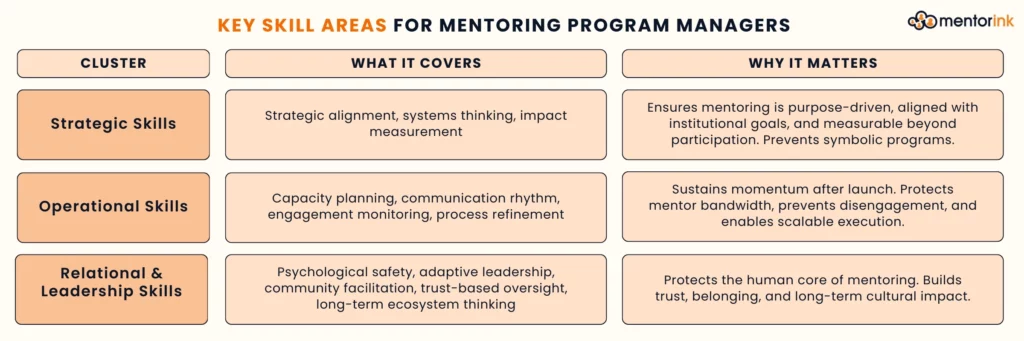
Below are the essential skill clusters that define high-performing mentoring program managers today.
Strategic Skills
Seeing the Bigger Picture and Designing for Impact
Strategic capability separates sustainable mentoring programs from short-lived initiatives.
Without strategic clarity, mentoring becomes activity-based rather than outcome-driven. High-performing program managers anchor every operational decision to a broader objective. They understand that mentoring must serve a defined need, not simply exist as a development trend.
Let’s explore the strategic capabilities in depth.
Strategic Alignment
The first question an effective mentoring program manager asks is not, “How do we match participants?”
It is, “Why does this program exist?”
Mentoring can serve many purposes: leadership pipeline development, knowledge transfer, DEI advancement, onboarding acceleration, alumni engagement, entrepreneurial support, or community capacity building. Each objective requires different structure, matching criteria, cadence, and measurement logic.
Skilled program managers consistently reconnect mentoring activity to institutional priorities. They ensure:
- The program has a clearly articulated purpose
- Stakeholders understand the intended outcomes
- Mentors and mentees know what success looks like
- Reporting reflects impact, not just participation
Strategic alignment protects mentoring from drifting into symbolic programming. It gives the initiative legitimacy and long-term credibility.
When alignment is strong, mentoring becomes strategic.
When it is weak, mentoring becomes symbolic.
That difference is strategic leadership.
Systems Thinking
Mentoring is not a single event. It is a living system.
Matching quality influences engagement. Engagement influences perceived value. Perceived value influences retention. Retention influences reporting outcomes. Reporting outcomes influence executive sponsorship. Everything is connected.
High-performing mentoring program managers think in systems, not tasks. When engagement declines, they do not immediately blame participants. They examine:
- Was onboarding clear?
- Were expectations realistic?
- Is mentor capacity stretched?
- Is communication cadence too infrequent?
- Is there visible leadership reinforcement?
Systems thinking prevents oversimplified conclusions. It also enables program managers to design mentoring as a cycle rather than a one-time launch. Each cohort becomes a source of learning that improves the next.
This capability transforms mentoring from operational coordination into program architecture.
Measurement and Impact Design
One of the most underestimated skills of mentoring program managers is defining what success actually means.
Many programs measure participation rates and meeting counts. While useful, those indicators alone do not capture developmental impact.
Strategically skilled program managers define success across multiple dimensions:
- Engagement consistency
- Goal progression
- Skill development confidence
- Retention or promotion trends
- Participant satisfaction
- Institutional alignment
They differentiate between activity metrics and outcome indicators.
More importantly, they design feedback loops. They understand that measurement is not only for reporting upward. It is for improving downward.
Measurement design ensures mentoring contributes to real growth rather than anecdotal success stories alone. Without impact design, mentoring remains invisible in strategic discussions. With it, mentoring earns a permanent seat at the table.
Operational Skills
Turning Strategy into Sustainable Execution
A mentoring program may be strategically sound, but without operational discipline, it will slowly lose momentum.
Operational excellence is what keeps mentoring alive after the kickoff event. It ensures that participation remains steady, mentors do not burn out, communication does not fade, and small issues do not turn into systemic disengagement.
Strong mentoring program managers understand that execution is not administrative work. It is momentum management.
Here are the core operational capabilities that distinguish effective program leadership.
Capacity Planning and Resource Management
Mentoring is built on human availability. And availability is finite.
One of the most common causes of declining program quality is mentor overload. When a small group of committed mentors carry disproportionate responsibility, burnout becomes inevitable. Quality drops quietly before participation does.
Effective mentoring program managers treat mentor capacity as a strategic resource. They:
- Assess realistic time commitments before cohort launch
- Monitor mentor-to-mentee ratios
- Balance distribution rather than defaulting to high-visibility leaders
- Anticipate expansion before increasing enrollment
Capacity planning also includes internal support resources. Who handles participant questions? Who manages rematching? Who compiles reports? Who analyzes engagement data?
When capacity is misjudged, friction increases. When capacity is intentionally designed, mentoring remains sustainable.
Operational maturity begins with respecting human bandwidth.
Structured Communication and Program Rhythm
Mentoring engagement rarely disappears overnight. It fades when visibility and reinforcement weaken.
Operationally skilled program managers create rhythm. They do not overwhelm participants with excessive reminders, nor do they disappear after launch. Instead, they design predictable communication touchpoints that reinforce structure without feeling intrusive.
This may include:
- Clear onboarding guidance
- Scheduled milestone reminders
- Midpoint reflections
- Light quarterly updates
- Visible leadership reinforcement
Rhythm creates psychological stability. Participants know what to expect and when.
Communication also shapes perception. When mentoring is referenced consistently in internal communications, it signals importance. When it is invisible, it feels optional.
Structured communication sustains momentum without micromanagement. It maintains presence without pressure.
Data Literacy and Engagement Monitoring
Modern mentoring programs generate data. But not all program managers know how to interpret it effectively.
Data literacy is not about dashboards. It is about pattern recognition.
Strong program managers monitor trends such as:
- Meeting consistency
- Scheduling gaps
- Platform inactivity
- Drop-off points in the program cycle
- Feedback sentiment
More importantly, they ask better questions when patterns shift.
- Is disengagement clustered around a specific month?
- Is onboarding too light?
- Are goals unclear?
- Is mentor preparation insufficient?
Data should not trigger immediate intervention. It should guide thoughtful inquiry.
Operationally mature managers use data as an early-warning system, not a control mechanism. This balance preserves autonomy while protecting program health.
When data is used wisely, it enhances trust rather than diminishing it.
Process Design and Continuous Improvement
No mentoring program runs perfectly in its first iteration.
Operational strength lies in refinement.
High-performing mentoring program managers treat each cohort as a learning cycle. They document friction points, analyze recurring questions, and update guidelines accordingly.
They refine:
- Matching criteria
- Orientation materials
- Feedback forms
- Communication timing
- Reporting frameworks
Continuous improvement transforms mentoring from static programming into an evolving capability.
This mindset ensures that mentoring becomes stronger with each cycle rather than repeating the same structural weaknesses.
Strategic clarity creates direction.
Operational discipline sustains movement.
Without operational skill, even the strongest mentoring strategy will struggle to deliver consistent results.
Relational and Leadership Skills
Managing the Human Dynamics Behind the Program
Mentoring programs are built on relationships. And relationships do not operate like spreadsheets.
They operate on trust, perception, motivation, psychological safety, and subtle human signals.
Even the most strategically aligned and operationally structured program can fail if participants do not feel safe, supported, and respected.
Effective mentoring program managers understand that they are not just administrators.
They are culture shapers.
Below are the leadership capabilities that distinguish truly exceptional program managers.
Psychological Safety Design
Psychological safety does not happen automatically.
Participants need to feel confident that mentoring conversations are developmental, not evaluative. They need to know that requesting support or rematching will not damage their reputation. They need clarity about confidentiality boundaries.
Skilled mentoring program managers proactively design safety into the system.
They:
- Clearly communicate confidentiality expectations
- Separate mentoring from performance evaluation processes
- Normalize feedback and adjustments
- Provide discreet channels for concerns
- Frame rematching as alignment, not failure
When psychological safety is present, participants speak honestly.
When it is absent, conversations remain surface-level.
The quality of mentoring conversations is directly linked to the perceived safety of the environment.
Psychological safety is not a soft concept. It is a structural leadership responsibility.
Adaptive Leadership
No mentoring program unfolds exactly as planned.
Unexpected friction will arise. A mentor may disengage. A mentee may change roles. Organizational priorities may shift mid-cycle. Participation may dip during busy seasons.
Adaptive mentoring program managers do not panic. They interpret.
They ask:
- Is this an isolated issue or a pattern?
- Is the structure too rigid?
- Is guidance too light?
- Has the context changed?
Adaptive leadership means adjusting without destabilizing the system. It requires discernment between temporary noise and structural weakness.
This skill prevents overcorrection. It also prevents inertia.
Programs led by adaptive managers evolve.
Programs led by rigid managers stagnate.
Community Facilitation
Mentoring programs thrive when participants feel part of something larger than their one-to-one relationship.
Effective program managers create light community structures that reinforce shared identity. This might include:
- Mentor roundtables
- Mentee peer discussions
- Cross-cohort reflection sessions
- Recognition events
- Impact storytelling
Community facilitation strengthens belonging. It also increases accountability.
When mentors feel part of a mentor community, they remain engaged longer.
When mentees see others progressing, motivation increases.
Mentoring shifts from transactional interaction to collective growth.
This capability transforms mentoring into culture-building.
Trust-Based Oversight
Oversight is necessary. Control is damaging.
Strong mentoring program managers walk a subtle line between visibility and autonomy. They monitor engagement and collect feedback, but they do not interfere with conversation content.
They design:
- Light-touch check-ins
- Clear but minimal reporting
- Safe feedback channels
- Transparent adjustment processes
Trust-based oversight signals respect.
Participants are more honest when they do not feel monitored.
Engagement is stronger when autonomy is preserved.
Leadership in mentoring is not about authority.
It is about stewardship.
Long-Term Perspective
Exceptional mentoring program managers think beyond one cycle.
They consider:
- How mentoring contributes to institutional memory
- How mentor communities can be sustained
- How alumni participants can remain connected
- How program insights inform broader talent strategy
This long-term orientation transforms mentoring from a temporary initiative into a structural capability.
Short-term administrators focus on launching cohorts.
Long-term leaders build mentoring ecosystems.
Bringing It All Together
Strategic skills provide direction.
Operational skills sustain execution.
Relational and leadership skills protect the human core of the program.
When these three clusters work together, mentoring programs shift from fragile initiatives to resilient systems.
Mentoring does not fail because people are unwilling.
It fails when systems lack clarity, capacity, or care.
Effective mentoring program managers bridge all three.
In 2026, mentoring leadership is no longer about coordination alone. It is about capability. The managers who develop these skills do not simply run programs. They build ecosystems that strengthen retention, accelerate development, and shape institutional culture over time.
Learn More About Mentoring Program Management
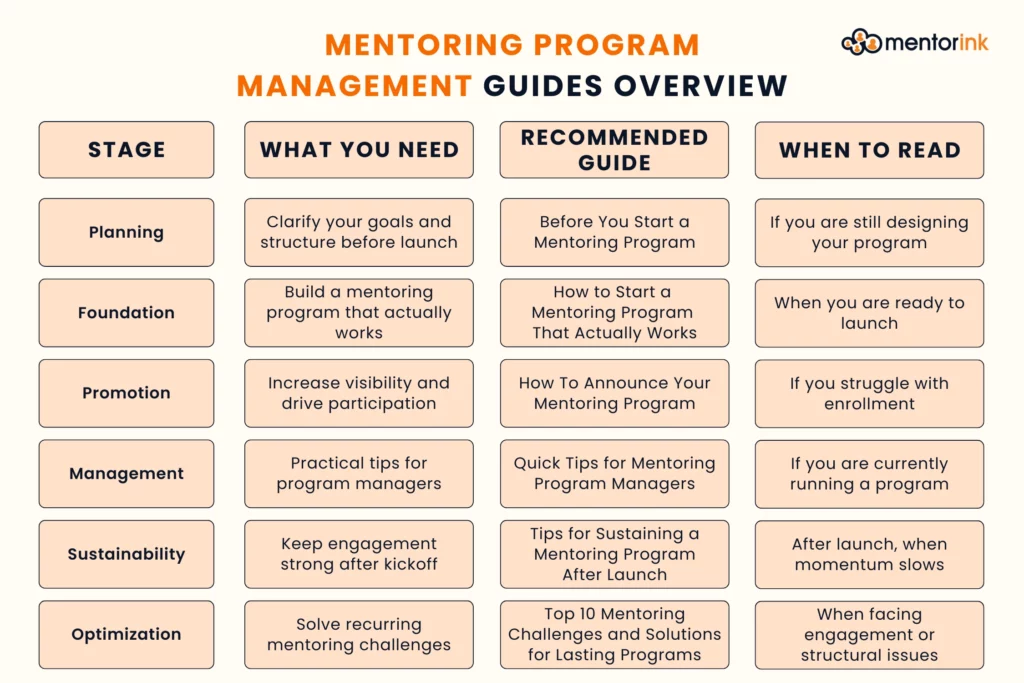
If you are building or improving a mentoring program, these guides can help you move forward with more clarity and structure.
- Thinking about launching a program? Start with Before You Start a Mentoring Program (2026 Guide)
- Ready to build the foundation? Read How to Start a Mentoring Program That Actually Works (2026 Guide)
- Need to drive participation? See How To Announce Your Mentoring Program
- Looking for practical guidance for program managers? Explore Quick Tips for Mentoring Program Managers (2026 Edition)
- Want to sustain momentum after launch? Read Tips for Sustaining a Mentoring Program After Launch (2026 Edition)
- Facing common mentoring challenges? See Top 10 Mentoring Challenges and Solutions for Lasting Programs
Want to talk it through with our team? You can pick a date that works for you here.